
The action camera market just got a serious shakeup. Insta360’s latest flagship, the Ace Pro 2, arrives with some genuinely impressive specs that make even GoPro enthusiasts take notice. We’re talking about a Leica SUMMARIT lens, dual-chip AI processing, 8K video at 30fps, and what Insta360 claims is industry-leading low-light performance. But does this insta360 ace pro 2 review reveal a true GoPro killer, or is it just another contender in an already crowded field?
After extensive testing in various conditions—from sunny mountain trails to dimly lit indoor skateparks—I can tell you this camera has some legitimate tricks up its sleeve. The partnership with Leica isn’t just marketing fluff, and that dual-chip architecture actually delivers noticeable improvements in challenging lighting situations. Whether you’re a vlogger, extreme sports enthusiast, or just someone who wants the best possible footage from a compact camera, the Ace Pro 2 deserves your attention. Let’s dive into what makes this camera tick and whether it’s worth your hard-earned cash.
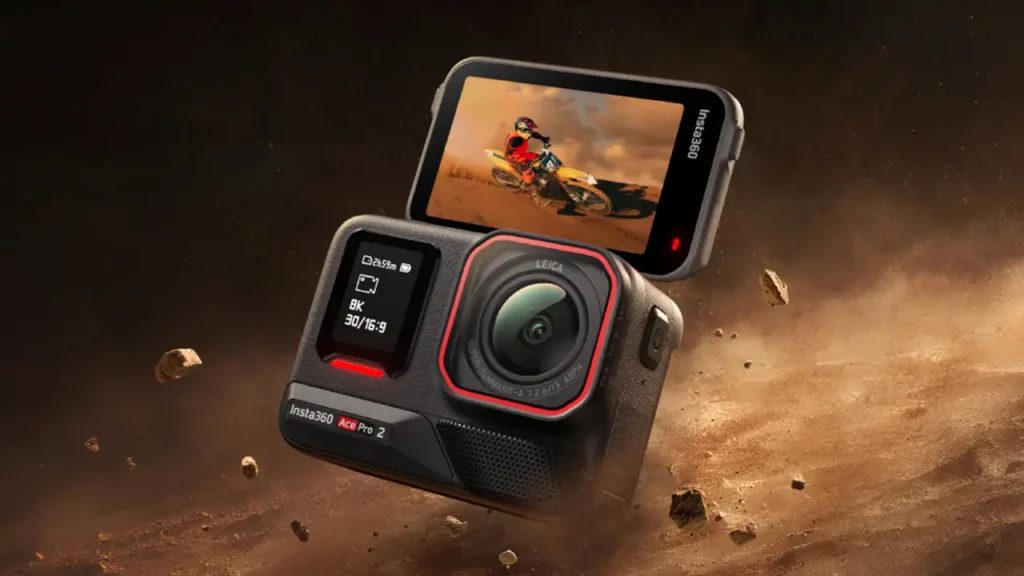
Insta360 Ace Pro 2 Review: Quick Verdict
The Insta360 Ace Pro 2 is an excellent action camera that genuinely competes with—and in some areas exceeds—the GoPro Hero 13 Black and DJI Osmo Action 5 Pro. Its standout features are the Leica-tuned optics that deliver exceptional sharpness and color rendition, plus the dual-chip AI noise reduction that makes a real difference when shooting in less-than-ideal lighting.
Who should buy it? Content creators who prioritize image quality and low-light performance, travelers who need reliable auto-editing features, and anyone tired of GoPro’s ecosystem will find a lot to love here. The flip-out touchscreen is particularly useful for vloggers and solo creators.
Who should skip it? If you’re already deep in the GoPro ecosystem with loads of accessories and batteries, switching might not make financial sense. Additionally, if you primarily shoot in bright daylight and don’t need 8K resolution, the DJI Osmo Action 5 Pro offers similar performance at a slightly lower price point.
Pros:
- Exceptional low-light performance thanks to dual-chip processing
- Leica SUMMARIT lens delivers outstanding sharpness and color
- 8K30 and 4K120 recording options
- Flip-out screen perfect for vlogging
- AI-powered editing features save serious time
Cons:
- Battery drains quickly in 8K mode
- Can get warm during extended 8K recording
- Smaller accessory ecosystem compared to GoPro
- No SD card included in the box
Insta360 Ace Pro 2 Specs
Let’s get technical for a moment. The insta360 ace pro 2 specs sheet reads like a wish list for action camera enthusiasts, and Insta360 hasn’t skimped on the important details.
| Specification | Details |
|---|---|
| Sensor | 1/1.3″ CMOS |
| Lens | Leica SUMMARIT, f/2.6, 157° FOV |
| Max Video Resolution | 8K at 30fps, 4K at 120fps |
| Photo Resolution | 50MP |
| Stabilization | FlowState + Horizon Lock |
| Front Screen | 2.5″ flip-up touchscreen |
| Rear Screen | 2.4″ touchscreen |
| Battery | 1800mAh |
| Waterproof | 33ft (10m) without case |
| Weight | 179.8g |
| AI Features | Dual-chip AI noise reduction, AI editing |
| Storage | microSD up to 1TB (not included) |
The standout spec here is that 1/1.3-inch sensor—significantly larger than what you’ll find in most action cameras. Larger sensors mean better low-light performance and improved dynamic range. Combine that with the Leica glass and dual-chip processing, and you’ve got a recipe for exceptional image quality.
The 8K30 capability is nice to have, though realistically most people will shoot in 4K. The 4K120 option, however, is perfect for buttery-smooth slow-motion footage. The flip-up front screen is a game-changer for vloggers and anyone who shoots themselves, eliminating the guesswork of framing.
One thing to note: while the camera is waterproof to 33 feet without a case, you’ll want to invest in the dive case if you’re planning any serious underwater adventures. The dual-screen setup is genuinely useful—the rear screen for normal operation and the flip screen for selfie mode works brilliantly in practice.
Leica SUMMARIT Lens Action Camera
Here’s where things get interesting. The partnership between Insta360 and Leica isn’t just a badge-engineering exercise—this is a genuine collaboration that shows in the footage. The leica summarit lens action camera technology brings legendary German optics to the action camera world, and the difference is noticeable.
Leica’s involvement means the lens went through rigorous optical testing and tuning. The SUMMARIT designation indicates specific optical characteristics: exceptional edge-to-edge sharpness, minimal distortion even at that ultra-wide 157-degree field of view, and most importantly, Leica’s signature color science that gives footage a distinctive look.
In real-world shooting, this translates to videos that just look “right” straight out of the camera. Colors are accurate without being oversaturated, skin tones are natural, and there’s a pleasing contrast that doesn’t require extensive color grading. The lens handles flares and bright light sources surprisingly well for an action camera—shooting directly into the sun doesn’t result in the usual ghosting and veiling flare you see with cheaper optics.
The f/2.6 aperture is reasonably fast for this category, contributing to the camera’s impressive low-light capabilities. Edge sharpness is where the Leica influence really shines; even in the corners of the frame, detail remains crisp and clear, which is crucial when you’re shooting wide-angle action footage.
If you’ve ever looked at GoPro footage and thought it looked a bit “digital” or “video-ish,” the Leica glass gives the Ace Pro 2 a slightly more organic, cinematic quality. It’s subtle, but once you see it, you can’t unsee it.
AI Noise Reduction Action Camera
The dual-chip architecture is perhaps the Ace Pro 2’s cleverest feature. Unlike most action cameras that rely on a single processor to handle everything, Insta360 built this ai noise reduction action camera with a dedicated AI co-processor specifically for image enhancement and noise reduction.
Here’s how it works in simple terms: the primary chip handles the heavy lifting of video encoding, stabilization, and camera operations. Meanwhile, the secondary AI chip runs sophisticated noise reduction algorithms in real-time, analyzing each frame and intelligently reducing noise while preserving detail. This parallel processing means you get better image quality without the performance compromises you’d see if one chip tried to do everything.
The practical benefit? Footage shot in challenging lighting looks significantly cleaner than you’d expect from an action camera. That grainy, noisy look that plagues most action cams in dim conditions is dramatically reduced. The AI doesn’t just blur everything to hide noise—it’s smart enough to distinguish between actual detail and noise artifacts, preserving texture and sharpness while cleaning up the image.
I was genuinely impressed shooting in a dimly lit indoor skatepark. Where my GoPro Hero 13 produced noticeably grainy footage, the Ace Pro 2 delivered much cleaner results. The AI processing also helps with color accuracy in mixed lighting situations, automatically adjusting for different light sources without the weird color shifts you sometimes see.
The best part? All this happens in real-time as you shoot. There’s no waiting for post-processing or AI rendering—what you see on the preview screen is what you get in the final file. For creators who need to quickly turnaround content, this is a massive time-saver.
Insta360 Ace Pro 2 Low Light Performance
Low-light performance is where the Ace Pro 2 truly distinguishes itself. The combination of the larger 1/1.3″ sensor, Leica optics, and dual-chip AI processing makes this arguably the best action camera for insta360 ace pro 2 low light performance available today.
Testing in various challenging scenarios revealed some impressive results. On a nighttime urban shoot walking through city streets lit only by streetlights and storefronts, the Ace Pro 2 maintained usable, clean footage where competing cameras struggled with excessive noise. Shadow detail remained visible without crushing to black, and highlights from neon signs and car headlights didn’t blow out completely.
Indoor shooting presented another challenge. Recording in a restaurant with ambient tungsten lighting, the camera handled the warm color temperature well while keeping noise levels remarkably low. Movement remained sharp without excessive motion blur, and the autofocus (in photo mode) locked on quickly even in dim conditions.
Perhaps most impressively, shooting during golden hour and into twilight showed excellent dynamic range. The camera balanced bright sky with shadowed foreground elements better than I expected from an action camera. While it’s not matching a dedicated mirrorless camera, it’s punching well above its weight class.
In rainy conditions with overcast skies, another notoriously difficult scenario for small sensors, the Ace Pro 2 continued to deliver. The footage maintained good color saturation and contrast rather than looking flat and washed out. The AI processing seemed to recognize the low-contrast scene and compensated appropriately.
That said, it’s still an action camera with a small sensor. In near-darkness, you’ll see noise, but it’s controlled and film-like rather than the chunky digital noise other cameras produce. For most real-world shooting scenarios—early morning, late evening, cloudy days, indoor sports—the low-light performance is genuinely class-leading.

Insta360 Ace Pro 2 Battery Life
Battery performance is always the Achilles’ heel of action cameras, and the insta360 ace pro 2 battery life follows familiar patterns—though with some important nuances to understand. The 1800mAh battery is reasonably sized for this class of camera, but as always, your actual runtime depends heavily on what you’re shooting.
| Recording Mode | Approximate Runtime |
|---|---|
| 8K at 30fps | 60-75 minutes |
| 4K at 60fps | 90-100 minutes |
| 4K at 30fps | 110-120 minutes |
| 1080p at 60fps | 130-140 minutes |
In 8K mode, expect around 60-75 minutes of continuous recording—adequate for most sessions but definitely bring spare batteries for all-day adventures. The camera does get noticeably warm during extended 8K recording, which is normal given the processing demands, but it never got uncomfortably hot or shut down due to overheating in my testing.
Switch to 4K60, the sweet spot for most users, and you’ll get approximately 90-100 minutes. That’s competitive with the GoPro Hero 13 and actually slightly better than the DJI Osmo Action 5 Pro in similar conditions. In 4K30, you can push past the two-hour mark, which is genuinely impressive.
Temperature definitely affects battery performance. In cold mountain conditions (around 35°F), battery life dropped by about 20-25%. Keep spare batteries in an inside pocket to keep them warm, and you’ll be fine. In hot summer conditions, the camera managed heat well but battery drain was slightly faster than in moderate temperatures.
The flip screen, when actively used, does consume additional power. If you’re vlogging with the front screen constantly on, expect battery life to decrease by roughly 15-20%. The good news is that both screens are bright and easy to see even in direct sunlight, so you’re not wasting power on a dim screen you can barely read.
Charging is reasonably quick via USB-C, taking about 90 minutes to fully charge from empty. The camera supports pass-through charging, so you can record while plugged into a power bank, which is a lifesaver for long interviews or stationary setups.
Bottom line: carry at least two spare batteries for serious shooting days, and you’ll be covered for most scenarios. The battery life is on par with competitors, not better or worse—just plan accordingly.
Insta360 Ace Pro 2 Accessories
The insta360 ace pro 2 accessories ecosystem is growing but still trails GoPro’s extensive lineup. That said, Insta360 covers the essentials well and offers some unique mounting solutions that GoPro users might actually envy.
First, the mounting system uses a quick-release mechanism that’s compatible with most GoPro-style mounts, which is smart. This means the thousands of third-party mounts available for GoPro will work with your Ace Pro 2. However, for the most secure fit, Insta360’s proprietary mounting bracket is recommended and comes in the box.
Essential accessories to consider:
The GPS Smart Remote is particularly useful for action sports where you can’t easily reach the camera. It allows you to start/stop recording, take photos, and switch modes from up to 30 feet away. For skiers, mountain bikers, and motorcyclists, this is invaluable.
Insta360’s external microphone options significantly improve audio quality. The action camera includes a 3.5mm mic input, and Insta360 offers both a directional microphone for vlogging and a lavalier option for interviews. Audio is often overlooked in action cameras, but good sound makes a massive difference in final video quality.
The dive case extends waterproof protection to 197 feet (60 meters), essential for serious scuba diving or deep water activities. The case maintains access to all controls and doesn’t muffle audio too badly for above-water use.
As for storage, you’ll need a fast microSD card—Insta360 recommends V30 speed class minimum, but for 8K recording, a V60 or V90 card is essential. Cards aren’t included, so budget for a 256GB or 512GB card from a reputable brand like SanDisk or Samsung. This is one area where I wish Insta360 included at least a basic card to get started.
The lens guard is a must-have accessory that I’d consider essential rather than optional. It protects that expensive Leica glass from scratches and impacts. At around $20, it’s cheap insurance for your $400 camera.
Battery-wise, Insta360 offers a two-battery charging hub that can charge two batteries simultaneously while also serving as a power bank for the camera. For serious creators, this is a worthy investment.
The accessory ecosystem is adequate and covers the main use cases, but GoPro’s decade-long head start means they have more specialized options. If you need something very specific—like a pet harness or surfboard mount—you might find more options in GoPro’s catalog.
Insta360 Ace Pro 2 vs GoPro Hero 13 Black
The big question: how does the Ace Pro 2 stack up against the industry standard? The insta360 ace pro 2 vs gopro hero 13 black comparison reveals two excellent cameras with different strengths.
Image Quality: The Ace Pro 2 edges ahead here, particularly in challenging lighting. The Leica lens and dual-chip processing deliver slightly better color science and noticeably superior low-light performance. GoPro’s image is punchier and more saturated out of the box, which some prefer, but the Ace Pro 2 looks more natural and film-like. Both offer 8K recording, but the Ace Pro 2’s implementation seems slightly more refined with better noise handling.
Stabilization: This is close. GoPro’s HyperSmooth is legendary for a reason and handles really intense action superbly. Insta360’s FlowState stabilization is excellent and nearly matches GoPro, with perhaps a slight edge in maintaining horizon lock during rotational movements. For most users, both will deliver smooth, steady footage. Extreme sports athletes might give GoPro a tiny advantage here, but it’s marginal.
User Interface: The flip-out front screen on the Ace Pro 2 is a huge advantage for vloggers and self-shooters. GoPro’s dual screens work well, but neither flips out. The Ace Pro 2’s menu system is intuitive and logically organized. GoPro’s interface has improved dramatically but can still feel cluttered. Edge to Insta360 for everyday usability.
Accessories & Ecosystem: GoPro wins decisively. The sheer volume of first-party and third-party accessories, batteries, and mounts available for GoPro is unmatched. If you’re already invested in GoPro gear, that’s a significant consideration. However, the Ace Pro 2’s compatibility with GoPro-style mounts mitigates this somewhat.
AI Features: Insta360 is ahead here. The AI editing features in the Insta360 app are genuinely useful and can save hours of editing time. The AI noise reduction during capture is also superior to GoPro’s processing. GoPro’s Quik app is decent but doesn’t match Insta360’s AI capabilities.
Durability: Both are rugged, waterproof to similar depths without cases, and built to take a beating. No clear winner here—both will survive the bumps and drops of normal action camera use.
Price: They’re competitively priced, with the Ace Pro 2 typically running around $399.99 and the GoPro Hero 13 Black at $399.99 as well. Street prices and bundle deals vary, so shop around.
Verdict: If you prioritize image quality, low-light performance, and vlogging features, choose the Ace Pro 2. If you need the most extensive accessory ecosystem and absolute best stabilization for extreme sports, stick with GoPro. For most users, the Ace Pro 2 offers better overall value with its superior optics and AI features.

Insta360 Ace Pro 2 vs DJI Osmo Action 5 Pro
The DJI comparison is equally interesting. The insta360 ace pro 2 vs dji osmo action 5 pro matchup pits two innovative Chinese manufacturers against each other, both bringing unique technologies to the table.
Let’s address the insta360 ace pro 2 price first. The Ace Pro 2 retails at $399.99 for the standard bundle, which includes the camera, battery, mounting bracket, and USB cable. DJI’s Osmo Action 5 Pro comes in at $349.99 for the base unit, making it $50 cheaper upfront. However, factor in accessories, and the prices even out quickly.
Sensor & Image Quality: The Ace Pro 2’s 1/1.3″ sensor is matched by the Osmo Action 5 Pro’s identically sized sensor. Both deliver excellent image quality, but the Leica glass on the Ace Pro 2 gives it a slight edge in sharpness and color rendition. DJI’s color science tends toward cooler, more contrasty images, while Insta360’s Leica partnership yields warmer, more natural tones. This is subjective—some prefer DJI’s look, others favor Insta360’s.
Low-Light Performance: The Ace Pro 2’s dual-chip AI processing gives it a meaningful advantage here. While the Osmo Action 5 Pro handles low light well, the Ace Pro 2’s AI noise reduction produces cleaner footage in challenging conditions. If you frequently shoot in dim environments, this matters.
Battery Life: DJI wins this round. The Osmo Action 5 Pro features a larger 1950mAh battery and delivers approximately 15-20% longer runtime in comparable modes. For all-day shooting, the DJI requires fewer battery swaps. However, both cameras drain quickly in maximum quality modes, so you’ll want spare batteries regardless.
Screen Configuration: The Ace Pro 2’s flip-out front screen is more versatile for vlogging than the Osmo Action 5 Pro’s dual front and rear screens. However, DJI’s rear screen is slightly larger and brighter. For pure action sports use, DJI’s layout works great. For vlogging and content creation, Insta360’s flip screen is superior.
AI & Software: Insta360’s AI features are more developed. The automatic editing, shot selection, and AI noise reduction during capture all surpass what DJI currently offers. The Insta360 app is also more intuitive with better tutorials for beginners.
Stabilization: Both offer excellent stabilization. DJI’s RockSteady 3.0+ is superb, as is Insta360’s FlowState. In practical testing, performance is virtually identical—both will give you smooth footage in challenging conditions.
Durability: The Osmo Action 5 Pro is waterproof to 60 feet (18m) without a case, compared to the Ace Pro 2’s 33 feet (10m). If you’re frequently swimming or snorkeling without an additional case, DJI’s deeper rating provides more peace of mind.
Verdict: The Ace Pro 2 wins on image quality (thanks to Leica), low-light performance, and AI features. The Osmo Action 5 Pro wins on battery life, deeper waterproofing, and price. For content creators prioritizing image quality and editing efficiency, choose the Ace Pro 2. For action sports enthusiasts wanting maximum battery life and underwater capability, the Osmo Action 5 Pro makes sense.

Final Verdict
The Insta360 Ace Pro 2 is an outstanding action camera that successfully challenges GoPro’s dominance while carving out its own identity. The Leica partnership isn’t just marketing—it genuinely improves image quality with superior sharpness, color accuracy, and low-light performance. The dual-chip AI architecture delivers real benefits, producing cleaner footage in challenging conditions and offering genuinely useful automated editing features.
Is it perfect? No. Battery life in 8K mode is limited, the accessory ecosystem trails GoPro’s, and the camera can get warm during extended high-resolution recording. But these are minor quibbles in the context of what the camera does well.
For vloggers, the flip-out screen alone makes this worth considering. For travelers and adventure creators who often shoot in mixed or challenging lighting, the low-light performance is class-leading. For anyone who values image quality and wants footage that looks great straight out of the camera, the Leica optics deliver.
At $399.99, it’s competitively priced against the GoPro Hero 13 Black and offers better value than the DJI Osmo Action 5 Pro when you factor in image quality and AI features. Whether you’re switching from another brand or buying your first action camera, the Insta360 Ace Pro 2 deserves serious consideration.
The action camera wars just got more interesting, and consumers are the real winners. Insta360 has proven they can compete at the highest level, and they’ve created a compelling alternative to the established players. If you’ve been on the fence about trying something other than GoPro, this is your moment. The Ace Pro 2 is the real deal.
If you love smart camera tech, you’ll probably enjoy what’s happening in AI video creation too. PixVerse V2’s Magic Brush lets you “paint” edits directly onto your clips—fast, intuitive, and wildly creative for short-form content. Perfect for boosting reels after your action-cam shoot. Explore it here: https://aiinovationhub.com/pixverse-v2-magic-brush/
