
What Panther Lake Actually Is (and why Series 3 matters)
Intel’s latest generation of mobile processors has arrived, and it’s making quite the entrance. The **Intel Panther Lake Core Ultra Series 3** represents more than just another incremental update—it marks a pivotal moment for both Intel’s manufacturing capabilities and their product lineup. Officially unveiled at CES 2026 in Las Vegas on January 5, this platform debuts as the first AI PC built entirely on Intel’s cutting-edge 18A process technology, designed and manufactured in the United States.
What sets Series 3 apart isn’t just the silicon inside, but what it represents for the broader computing landscape. Intel is positioning these processors to power over 200 different PC designs from leading global partners, making it potentially their most broadly adopted AI PC platform to date. From thin-and-light ultrabooks to gaming powerhouses, from 2-in-1 tablets to edge computing devices and even robotics applications, Panther Lake aims to be everywhere. The timing couldn’t be more strategic. With this launch, Intel brings together improvements in CPU performance, significantly enhanced integrated graphics, expanded AI capabilities through an upgraded NPU, and notably improved power efficiency—all critical factors as the industry transitions toward AI-enhanced computing experiences.
Jim Johnson, Senior Vice President and General Manager of Intel’s Client Computing Group, emphasized the focus during the launch event, highlighting laser-focused improvements on power efficiency, CPU performance, GPU capabilities, and AI compute power. For Intel, the stakes at CES 2026 were higher than ever. Over the past year, both NVIDIA and the US government acquired ownership stakes in the company, helping nearly double the stock price by year’s end. This launch represents Intel’s opportunity to prove they can deliver on their ambitious “5 Nodes in 4 Years” roadmap while competing head-to-head with TSMC, AMD, Qualcomm, and NVIDIA in the AI hardware space.
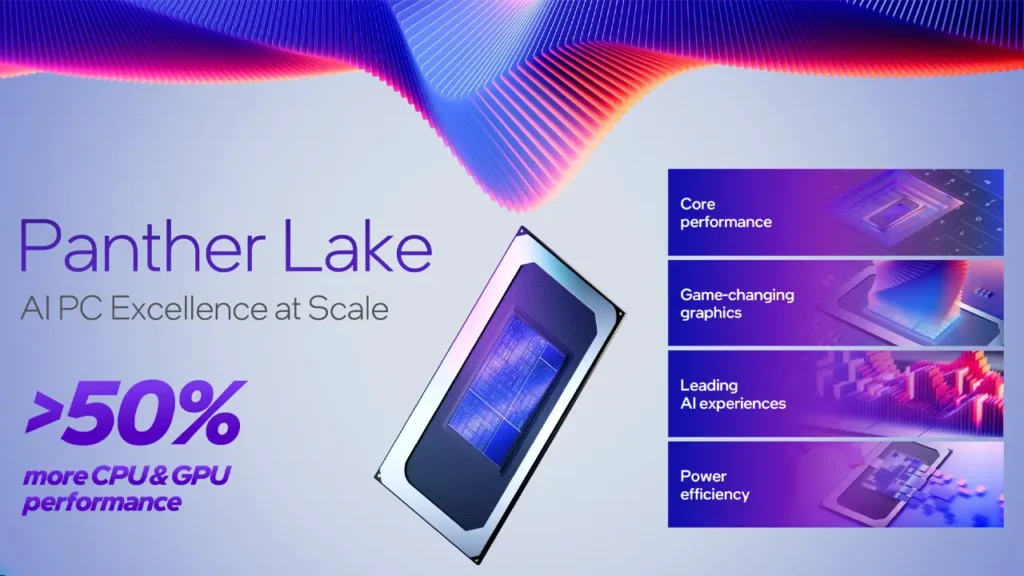
Intel Panther Lake 18A — the headline upgrade
The real star of this show is the process technology underneath everything. **Intel Panther Lake 18A** isn’t just a marketing name—it’s Intel’s most advanced semiconductor manufacturing process ever developed and manufactured on American soil. The “18A” designation refers to 18 angstroms, which places it in the sub-2nm class of manufacturing nodes. This makes it one of the most advanced process nodes in the world, competing directly with TSMC’s upcoming 2nm technology.
What makes this launch particularly significant is that Panther Lake is Intel’s first high-volume consumer product built on 18A. Previous generations like Arrow Lake relied on third-party fabrication from TSMC, but Panther Lake marks Intel’s return to manufacturing leadership with their own cutting-edge process. The chips are being produced at Intel’s Fab 52 in Chandler, Arizona, along with facilities in Oregon—both state-of-the-art factories that Intel claims are “the most advanced semiconductor facilities not only in the U.S. but in the world.”
The transition to 18A brings substantial improvements across the board. Intel is claiming 60% better multithreaded performance at the same power level compared to previous generations. Battery life has also seen dramatic improvements, with devices achieving up to 27 hours when streaming Netflix or up to 9 hours of Microsoft Teams video conferencing with studio effects enabled. These aren’t just incremental gains—they represent the kind of generational leap that can redefine what’s possible in mobile computing.
Manufacturing chips in the United States using the most advanced process technology available also carries geopolitical significance. As global semiconductor supply chains face increasing scrutiny and nations push for technological sovereignty, Intel’s ability to produce cutting-edge chips domestically strengthens both the company’s position and America’s technology leadership. The 18A process represents billions of dollars in investment and years of research, and its successful deployment in Panther Lake validates Intel’s ambitious roadmap.
Intel 18A process technology explained (simple, not “marketing”)
Let’s break down what **Intel 18A process technology** actually means without drowning in marketing speak. At its core, 18A introduces two revolutionary technologies: RibbonFET and PowerVia. These aren’t just fancy names—they’re fundamental reimaginations of how transistors work and how power flows through a chip.
RibbonFET is Intel’s implementation of gate-all-around (GAA) transistor technology. Think of traditional FinFET transistors like fins of silicon standing upright, with the gate controlling them from three sides. RibbonFET takes this further by completely wrapping the gate around sheets (or “ribbons”) of silicon stacked on top of each other. Chris Auth, VP and Director of Advanced Technology Programs at Intel, explained that unlike FinFETs which have a weak spot at the bottom, RibbonFET has “no weak points” because the gate completely wraps around each silicon ribbon.
This complete wraparound provides superior control over electrical current, which translates to two major benefits: better performance and less power leakage. As chips get smaller and denser, power leakage becomes a critical problem. RibbonFET’s architecture allows Intel to continue scaling transistor density while keeping power consumption in check—essential for battery-powered devices.
PowerVia is equally revolutionary. For six decades, all integrated circuits have delivered power through the front side of the wafer, where both power lines and signal lines compete for space. Intel’s PowerVia flips this convention by moving power delivery to the backside of the chip. This separation provides several advantages: power lines can be made larger and more efficient without interfering with signal routing, signal lines have more room to spread out and minimize interference, and overall chip utilization improves by 5-10%.
Together, RibbonFET and PowerVia enable Intel 18A to deliver performance improvements of 18-25% at the same power level compared to Intel’s previous 3nm-class process, or power reductions of 36-38% at the same performance level. The process also achieves roughly 30% better density, meaning more transistors can be packed into the same area. These aren’t theoretical numbers—they’re demonstrated in actual silicon shipping in Panther Lake devices.
The 18A process uses extreme ultraviolet (EUV) lithography for critical layers, enabling the fine precision required for sub-2nm features. Intel has also introduced High Numerical Aperture (High NA) EUV capabilities, allowing even smaller features to be printed cost-effectively. All of this is supported by a robust ecosystem of over 35 industry partners spanning EDA tools, IP providers, design services, and cloud partners.
| Technology | Key Innovation | Benefit |
|---|---|---|
| RibbonFET | Gate-all-around transistors | Better current control, reduced power leakage |
| PowerVia | Backside power delivery | 5-10% better cell utilization, improved signal integrity |
| 18A Node | Sub-2nm manufacturing | 30% better density, 18-25% performance gain |
Core Ultra Series 3 laptops — when real devices hit the market
The big question everyone wants answered: when can you actually buy **Core Ultra Series 3 laptops**? Intel officially launched the platform at CES 2026 on January 5, with retail availability scheduled for January 27, 2026. Pre-orders opened immediately after the announcement, giving eager buyers about three weeks to secure their orders before general availability.
Over 200 different PC designs are expected to reach the market throughout the first half of 2026, representing partnerships with virtually every major OEM. This includes household names like ASUS, MSI, Lenovo, Dell, HP, Acer, and many others. The diversity of form factors is impressive—traditional clamshell laptops, 2-in-1 convertibles, gaming rigs, ultraportables, mini PCs, tablets, and even gaming handhelds.
Intel has structured the Core Ultra Series 3 lineup to cover a broad spectrum of use cases and price points. The lineup includes 14 confirmed SKUs at launch, spanning Core Ultra 5, Core Ultra 7, and Core Ultra 9 tiers, plus Core Ultra X7 and Core Ultra X9 variants with beefier integrated graphics. Unlike the previous generation which split between Lunar Lake (low-power) and Arrow Lake-H (high-performance), Panther Lake unifies everything under a single platform architecture, offering scalability across the entire mobile market.
The modular, multi-chiplet design allows manufacturers to configure devices with different balances of CPU cores, GPU cores, and features depending on their target market. A thin-and-light business ultrabook might prioritize efficiency and battery life, while a gaming laptop emphasizes raw performance and graphics capabilities. This flexibility means consumers will see Panther Lake devices at various price points, from affordable mainstream laptops to premium flagship systems.
Early design wins showcase the platform’s versatility. We’re seeing everything from sub-1kg ultraportables like MSI’s Prestige 13 AI+ to powerful gaming machines with discrete GPUs, and from productivity-focused 2-in-1 tablets to specialized edge computing devices. Beyond traditional PCs, Intel is also certifying Panther Lake for embedded and industrial applications, including robotics, smart cities, and edge AI deployments—markets that demand 24/7 reliability and operation across extreme temperature ranges from -40°C to 100°C.
Panther Lake benchmark talk — what early tests suggest
Let’s talk about **Panther Lake benchmark** results, keeping in mind these are early pre-production numbers and final retail devices may perform even better. The most tested chip so far has been the Core Ultra 9 386H, Intel’s flagship processor for gaming laptops that pairs with discrete GPUs.
In Geekbench 6 testing, the Core Ultra 9 386H scored around 2,845 points in single-core and 15,407 points in multi-core tests. These numbers are impressive when you consider the chip’s configuration—just 4 Performance cores, 8 Efficient cores, and 4 Low Power Efficient cores, all running at frequencies up to 4.9 GHz. That’s fewer large cores than previous-generation chips, yet the architectural improvements and 18A process enable it to outperform chips with higher core counts.
Comparing against the competition, the Core Ultra 9 386H sits about 16% ahead of AMD’s Ryzen AI 9 HX 370 in multi-threaded performance and over 50% faster than Intel’s own Lunar Lake 8-core chips. Perhaps most impressively, it matches the performance of Intel’s own Core i9-14900HX, a 24-core chip from the previous generation, despite having significantly fewer cores. This demonstrates the efficiency gains from the new architecture and manufacturing process.
Intel’s official performance claims are equally bold. For graphics, they’re citing 77% faster performance compared to the Core Ultra 9 288V (Lunar Lake) and 73% better gaming performance versus AMD’s HX 370 processor. The Arc B390 integrated GPU configuration with 12 Xe3 cores is positioning itself as a discrete-class solution for thin-and-light devices. For AI workloads, Intel claims 4.3 times the LLM performance compared to AMD’s HX 370 and double the performance of their own Core Ultra 200H series.
Battery life benchmarks are showing real-world improvements that matter to users. Devices are achieving up to 27 hours of Netflix streaming in testing conditions, and up to 9 hours of Microsoft Teams video conferencing with AI-powered studio effects enabled—tasks that typically drain batteries quickly. These aren’t laboratory numbers either; they represent real usage scenarios that users will experience daily.
One caveat: these are early benchmarks from pre-production hardware, often running non-final BIOS and drivers. History suggests that performance typically improves between pre-launch samples and retail devices as manufacturers fine-tune their implementations. The numbers we’re seeing now likely represent the floor, not the ceiling, of what Panther Lake can deliver.

| Processor | Single-Core (Geekbench 6) | Multi-Core (Geekbench 6) | Core Count |
|---|---|---|---|
| Core Ultra 9 386H (Panther Lake) | ~2,845 | ~15,407 | 16 (4P+8E+4LP) |
| Ryzen AI 9 HX 370 | ~2,700 | ~13,300 | 12 |
| Core i9-14900HX | ~2,700 | ~15,400 | 24 (8P+16E) |
| Core Ultra 9 288V (Lunar Lake) | ~2,650 | ~10,200 | 8 (4P+4E) |
Panther Lake AI PC — NPU, TOPS, and real use-cases
The **Panther Lake AI PC** capabilities center around Intel’s new NPU 5 architecture, which delivers 50 TOPS (trillions of operations per second) of dedicated AI processing power. This meets and exceeds Microsoft’s Copilot+ PC requirements for 2026, positioning Panther Lake devices to take full advantage of Windows’ latest AI features.
But raw TOPS numbers only tell part of the story. The real innovation is in the balanced XPU architecture that distributes AI workloads across the CPU, GPU, and NPU for optimal performance. The platform delivers up to 180 total TOPS when combining all three processors: 50 TOPS from the NPU, up to 120 TOPS from the Arc B390 graphics, and the remainder from CPU-based AI acceleration. This heterogeneous approach allows the system to intelligently route AI tasks to whichever processor can handle them most efficiently.
Real-world AI use cases are where this matters. Local LLM (Large Language Model) inference—running AI assistants directly on your device without cloud connectivity—sees particularly dramatic improvements. Intel claims 4.3 times better LLM performance compared to AMD’s competing solutions, enabling responsive AI assistants that work even offline. This is crucial for privacy-sensitive applications where users don’t want their data leaving their device.
The NPU 5 handles dedicated AI workloads like real-time video translation, background blur and noise cancellation in video calls, AI-powered photo and video editing, voice recognition and transcription, and local AI coding assistants. These run continuously with minimal impact on battery life because the NPU is specifically designed for power-efficient AI inference. The CPU and GPU remain free to handle other tasks, preventing the system slowdowns that plagued earlier AI implementations.
For content creators, the AI capabilities enable features like real-time image enhancement, automatic video stabilization and color grading, AI-assisted audio cleanup and enhancement, and predictive text and code completion. The Arc Xe3 graphics architecture includes dedicated AI acceleration units that work in tandem with Intel’s XeSS3 upscaling technology and multi-frame generation, delivering better gaming performance and image quality.
Enterprise and commercial users benefit from enhanced security features powered by AI, including behavioral threat detection, real-time phishing prevention, and AI-powered data loss prevention. The platform’s certification for embedded and industrial use extends these AI capabilities to edge computing scenarios like robotic vision processing, predictive maintenance analytics, real-time video analytics for smart cities, and autonomous system navigation.
Microsoft’s integration of Copilot+ features depends heavily on these local AI capabilities. Real-time meeting transcription and translation, AI-powered Windows Studio Effects for video calls, Paint Cocreator and Photos Cocreator using local generative AI, and enhanced Windows Search using semantic understanding all benefit from the 50 TOPS NPU delivering responsive, private AI processing without constant cloud dependency.
Panther Lake gaming laptop angle — why this gen is different
The **Panther Lake gaming laptop** story is particularly interesting because Intel is taking a different approach than previous generations. The Core Ultra 9 and Core Ultra 7 gaming-focused SKUs (those ending in “H” like 386H) feature just 4 Xe3 graphics cores—enough for video output and light gaming, but clearly designed to be paired with discrete GPUs from NVIDIA or AMD.
This might seem like a step backward until you understand the reasoning. By reducing the integrated GPU size on gaming-focused chips, Intel can dedicate more of the chip’s thermal budget and package space to what gamers actually care about: CPU performance and power efficiency. A gaming laptop with an RTX 5070 or 5080 isn’t relying on integrated graphics anyway, so why waste die space and thermal capacity on 12 Xe3 cores that won’t be used?
The result is impressive. Gaming laptops like Thunderobot’s ZERO Air can achieve incredible form factors—15.9mm thin and just 1.58kg—while still packing serious hardware including a Core Ultra 9 386H and RTX 5070. That’s ultrabook territory for weight, yet with gaming laptop performance. The 60% improvement in multithreaded performance at the same power level translates directly to better framerates, faster game loading, and superior 1% lows during intense gaming sessions.
Intel’s claims of 73% better gaming performance compared to AMD’s HX 370 are based on testing with discrete GPUs, where CPU performance actually matters. Modern games increasingly rely on CPU processing for physics, AI, and complex game logic. A faster CPU can prevent GPU bottlenecks, deliver more consistent framerates, and enable better performance in CPU-intensive titles like strategy games, simulators, and competitive multiplayers.
The power efficiency gains are game-changing for mobile gaming. Previous-generation gaming laptops could drain their batteries in 2-3 hours during gameplay. Panther Lake’s efficiency improvements enable longer gaming sessions away from the wall, and more importantly, allow manufacturers to build thinner, lighter laptops without sacrificing performance. When you’re not gaming, the intelligent power management can scale down to sipping power during web browsing or video streaming, maximizing battery life.
For enthusiasts who want integrated graphics performance without a discrete GPU, Intel offers the Core Ultra X9 and X7 variants featuring 12 Xe3 cores with the Arc B390 GPU. These deliver approximately 75-80% better graphics performance than previous-generation integrated solutions and can handle modern games at 1080p with medium-to-high settings—impressive for integrated graphics.
The gaming laptop market for Panther Lake is already showing strong OEM support. MSI, ASUS, Lenovo, HP, Acer, and numerous smaller manufacturers have announced gaming laptops featuring the new platform, many combining Panther Lake CPUs with NVIDIA’s RTX 50 series GPUs for a complete next-gen gaming system. Expect to see these hitting stores and online retailers starting January 27, 2026.
Thunderobot Zero Air Panther Lake — one of the first China demos
The **Thunderobot Zero Air Panther Lake** laptop represents one of the most exciting early implementations of Intel’s new platform, showcasing what’s possible when you combine cutting-edge silicon with thoughtful engineering. Thunderobot, a Chinese gaming laptop manufacturer, unveiled the Zero Air at CES 2026 as one of the first production-ready devices featuring Panther Lake.
The headline-grabbing spec is the weight: just 1.58kg (approximately 3.5 pounds) for a full 15.3-inch gaming laptop. To put that in perspective, that’s lighter than many 13-inch ultrabooks and barely heavier than a MacBook Air 15-inch, yet the Zero Air packs hardware that would have required a 2.5kg+ chassis just a generation ago. The laptop measures only 15.9mm thick, thinner than many business notebooks.
Inside, the Zero Air features Intel’s Core Ultra 9 386H processor—the flagship gaming SKU with 16 cores running up to 4.9 GHz. This is paired with NVIDIA’s GeForce RTX 5070 mobile GPU, creating a 160W “full power” system capable of handling demanding AAA games and creative workloads. The combination delivers what Thunderobot claims is 50% better multi-core performance with 30% less power consumption compared to the previous generation.
The display is a 15.3-inch OLED panel running at 2560×1440 resolution (2.5K) with a 165Hz refresh rate. That’s a sweet spot for gaming—higher resolution than standard 1080p for sharper visuals, but not as demanding as 4K, allowing the RTX 5070 to stretch its legs. The OLED technology provides perfect blacks, a 1,000,000:1 contrast ratio, 100% DCI-P3 wide color gamut, and factory color calibration for content creators.
Memory and storage flexibility is excellent, with dual DDR5 memory slots supporting up to 32GB and dual Gen4 NVMe SSD slots with up to 1TB. The modular approach means users can upgrade down the road rather than being stuck with soldered components. Connectivity includes rear-mounted Ethernet, HDMI, USB Type-A, and USB Type-C ports—a smart layout that keeps cables out of the way during gaming sessions.
Cooling is a particular engineering challenge in such a thin chassis with high-power components. Thunderobot uses a dual-fan system with a vapor chamber heat spreader, along with quad heat pipes to move thermal energy away from the CPU and GPU. Early demonstrations at CES showed the system maintaining stable performance even under sustained stress testing, suggesting the cooling solution is up to the task.
The Zero Air supports 100W USB-C PD charging, which is noteworthy for a gaming laptop. Most devices in this performance class require proprietary power bricks delivering 180W or more. The ability to charge via standard USB-C—albeit at reduced power for lighter workloads—adds tremendous flexibility for travelers who can use a single charger for their laptop, phone, and other devices.
Pricing hasn’t been officially announced, but based on the specifications and positioning, expect the Zero Air to land in the premium thin-and-light gaming segment, likely around $1,800-$2,400 USD depending on configuration. That positions it as a direct competitor to devices like the ASUS ROG Zephyrus G14, MSI Stealth series, and Razer Blade 14.

OneXPlayer Super V Panther Lake — handheld/2-in-1 goes next-gen
The **OneXPlayer Super V Panther Lake** takes a different approach to showcasing the platform’s capabilities, targeting the burgeoning market for high-performance 2-in-1 tablets and gaming devices. OneXPlayer, a Chinese manufacturer known for pushing the boundaries of handheld PC gaming, unveiled the Super V at CES 2026 as one of the first Panther Lake-based tablets.
The Super V is built around the Intel Core Ultra X7 358H processor, which features 16 cores in a 4+8+4 configuration (4 Performance, 8 Efficient, 4 Low Power Efficient cores) boosting up to 4.8 GHz. Crucially, this SKU includes the Arc B390 integrated GPU with 4 Xe3 cores, providing enough graphics horsepower to handle gaming without a discrete GPU—essential in a tablet form factor where space and thermal constraints are even tighter.
The display is a 14-inch OLED panel with 2880×1800 resolution (2.8K) and a 120Hz refresh rate. OLED technology is perfect for a tablet where viewing angles and color accuracy matter, and the high refresh rate ensures smooth gaming and general use. The display supports both touch and pen input, with OneXPlayer bundling a 4096-level pressure-sensitive stylus—making the Super V viable not just for gaming but for digital art and note-taking.
What makes the Super V particularly interesting is its modular design. It includes a detachable magnetic keyboard with RGB backlighting and full-size keys, plus an integrated kickstand. This transforms the tablet into a proper laptop replacement when needed, while maintaining the portability and versatility of a tablet form factor. The pogo pin connection between keyboard and tablet provides both data transfer and charging for the keyboard’s RGB lighting.
Storage flexibility is enhanced by support for mini SSD cards in addition to a standard M.2 2280 SSD slot. This allows users to swap high-speed storage on the fly—useful for photographers, videographers, and gamers who want to carry multiple game libraries. Early product demonstrations showed configurations with up to 64GB of DDR5 memory, though retail SKUs will likely offer various memory tiers.
The Super V is positioned as a more affordable alternative to OneXPlayer’s Super X tablet, which uses AMD’s powerhouse Ryzen AI Max+ 395 APU with 40-core Radeon 8060S graphics. While the Super X offers superior raw graphics performance (and a starting price around $1,899 on Kickstarter), the Super V’s Arc B390 should still deliver respectable gaming performance at 1080p-1440p resolutions with appropriate settings. Intel’s claims of 77% better graphics performance compared to previous generation integrated solutions suggest the Arc B390 can handle modern titles.
For gaming, the Super V represents a compelling middle ground between traditional gaming handhelds like the Steam Deck and full gaming laptops. The 14-inch display is large enough for productive work and comfortable gaming, yet the tablet form factor means you can detach the keyboard and play handheld-style when desired. The kickstand enables tabletop gaming with a controller, or propping up the tablet for media consumption.
OneXPlayer hasn’t announced official pricing or availability for the Super V yet, but based on the specifications and the company’s typical pricing strategy, expect it to land somewhere between $1,200-$1,600 depending on configuration. That would position it below the Super X but above budget gaming tablets, targeting enthusiasts who want serious performance in a portable form factor.
The Super V showcases Panther Lake’s versatility beyond traditional laptops. The combination of strong CPU performance, capable integrated graphics, and excellent power efficiency makes it possible to build devices that were simply impractical with previous-generation technology. We’re likely to see many more innovative form factors emerge as Panther Lake matures throughout 2026.
Intel Core Ultra 9 386H — the chip name you’ll keep seeing
The **Intel Core Ultra 9 386H** deserves its own section because it’s arguably the most important chip in the Panther Lake lineup—at least for gaming and performance-oriented laptops. This is Intel’s flagship mobile processor for systems that pair with discrete GPUs, and it’s the chip you’ll see in most high-end gaming laptops, mobile workstations, and performance notebooks throughout 2026.
Let’s break down what those numbers and letters mean. “Core Ultra 9” indicates this is a top-tier consumer processor. “386” is the processor number within the Series 3 family (higher numbers generally indicate better specifications). The “H” suffix designates this as a high-performance mobile processor designed for laptops that prioritize performance over absolute battery life—typically gaming notebooks, mobile workstations, and powerful productivity machines.
The core configuration is 4 Cougar Cove Performance cores, 8 Darkmont Efficient cores, and 4 Darkmont Low Power Efficient cores, totaling 16 cores and 16 threads. Unlike previous Intel generations that used Hyper-Threading to double thread counts, Panther Lake’s efficient cores are single-threaded, which actually simplifies scheduling and can improve power efficiency. The P-cores run from 2.1 GHz base up to 4.9 GHz boost, while E-cores span 1.6-3.9 GHz and LP-E cores operate at 1.6-3.5 GHz.
Cache configuration includes 18MB of L3 cache shared across all cores, plus 8MB of L2 cache distributed among the cores. This substantial cache helps reduce memory latency and improves performance in applications that frequently access the same data. The integrated memory controller supports up to 96GB of LPDDR5X-8533 or 128GB of DDR5-7200, providing ample bandwidth for memory-intensive workloads.
Power management is sophisticated, with the 386H supporting three key power states: Minimum Assured Power of 15W for extreme efficiency scenarios, Processor Base Power (PL1) of 25W representing the sustained performance level, and Maximum Turbo Power of 80W for short-duration burst performance. This flexibility allows manufacturers to tune the chip for different chassis designs—a thin ultraportable might keep it mostly at 25W for thermals and battery life, while a thicker gaming laptop can let it stretch to 80W during intensive gaming sessions.
The integrated graphics consist of just 4 Xe3 cores with Intel Graphics 4 branding. This is intentional—the 386H is designed for systems with discrete GPUs, so the integrated graphics only need to handle display output, video decode/encode, and basic 2D work. This allows Intel to dedicate more die space and thermal budget to what matters most in these systems: CPU performance.
Platform features include support for up to 20 PCIe lanes (more than other Panther Lake variants), 4 Thunderbolt 4 ports, Wi-Fi 7 (Release 2), and Bluetooth Core 6.0. The NPU 5 delivers 50 TOPS of AI processing, plus there’s an IPU 7.5 image processor for advanced camera features. All of this is manufactured using Intel’s 18A process for the compute tile, with TSMC’s N6 process used for the platform controller tile.
Real-world performance, as we discussed earlier, shows the 386H matching or exceeding processors with significantly higher core counts thanks to the efficiency of the new architecture and manufacturing process. In early Geekbench testing, it scored around 2,845 in single-core and 15,407 in multi-core, positioning it at the top of the mobile CPU performance rankings.
You’ll see the Core Ultra 9 386H in flagship gaming laptops from virtually every major manufacturer: ASUS ROG, MSI, Lenovo Legion, HP OMEN, Acer Predator, Alienware, Razer, and many others. It’s also appearing in mobile workstations for professionals who need serious computational power on the go—3D modelers, video editors, data scientists, and software developers. Some manufacturers are even using it in compact desktop systems and mini PCs where space constraints favor mobile chips over desktop processors.
| Specification | Intel Core Ultra 9 386H |
|---|---|
| Architecture | Panther Lake (18A process) |
| Cores/Threads | 16 cores / 16 threads (4P+8E+4LP) |
| Base/Boost Clock | 2.1 GHz / 4.9 GHz |
| Cache | 18MB L3, 8MB L2 |
| Integrated GPU | Intel Graphics 4 (4 Xe3 cores) |
| NPU | NPU 5 (50 TOPS) |
| TDP | 25W base (15W min, 80W max) |
| Memory Support | DDR5-7200 (128GB) / LPDDR5X-8533 (96GB) |
| Launch Date | January 27, 2026 |

Final Thoughts
Intel’s Panther Lake Core Ultra Series 3 represents a genuine inflection point in mobile computing. The combination of industry-leading 18A manufacturing, innovative RibbonFET and PowerVia technologies, and carefully architected silicon delivers the kind of generational leap that has become increasingly rare in an industry where progress often feels incremental.
What makes this launch particularly significant is the breadth of improvements. Previous generations often excelled in one area—maybe performance or maybe efficiency—but struggled elsewhere. Panther Lake delivers across the board: better CPU performance, dramatically improved graphics, meaningful AI capabilities, and superior power efficiency all in a single platform. This holistic improvement is what enables devices like the Thunderobot Zero Air and OneXPlayer Super V that were simply impossible to build with previous-generation technology.
For consumers, the immediate takeaway is simple: if you’re in the market for a new laptop, tablet, or handheld PC in 2026, devices powered by Intel’s Core Ultra Series 3 processors deserve serious consideration. The improvements in battery life alone make upgrading worthwhile for many users, and the AI capabilities provide a foundation for features that will only become more important as software catches up to hardware.
For Intel, Panther Lake is validation of their ambitious “5 Nodes in 4 Years” roadmap and proof that American semiconductor manufacturing can compete at the absolute cutting edge of technology. The successful volume production of 18A in Arizona and Oregon facilities isn’t just a corporate achievement—it’s a strategic win for technology independence and supply chain resilience.
The devices showcased at CES 2026 are just the beginning. As more manufacturers bring Panther Lake designs to market throughout 2026, we’ll see increasingly innovative implementations that push the boundaries of what’s possible in mobile computing. With over 200 designs in the pipeline and strong OEM support, Panther Lake looks positioned to be Intel’s most successful mobile platform in years.
Whether you’re a gamer looking for the perfect balance of performance and portability, a professional needing serious computational power on the go, or just someone who wants a laptop that lasts all day and handles modern AI features smoothly, the Core Ultra Series 3 platform delivers. January 27, 2026 marks the start of retail availability, and the race is on to see which manufacturers can deliver the most compelling implementations of Intel’s most advanced mobile silicon to date.
If you think the laptop chip race is intense, wait until you see how China is challenging legends on two wheels. GWM’s Souo is being compared head-to-head with the Honda Gold Wing, and the details are surprisingly bold. Specs, comfort, tech, and real-world touring vibes — it’s all here: https://autochina.blog/gwm-souo-vs-honda-goldwing-comparison/
