
The story of home robotics started simple—vacuum cleaners that knew how to avoid your couch. Today, we’re watching something bigger unfold: home humanoid robots that can actually pick things up, recognize objects, and help with real household tasks. This isn’t science fiction anymore; it’s the natural next step after robot vacuums, and it’s powered by something called embodied AI.
If you’ve ever wondered what comes after your Roomba, or why tech companies are suddenly building robots with arms and legs, you’re in the right place. Let’s explore how home humanoid robots work, what they can actually do in your house, and what you need to know about safety, privacy, and cost before one shows up at your door.
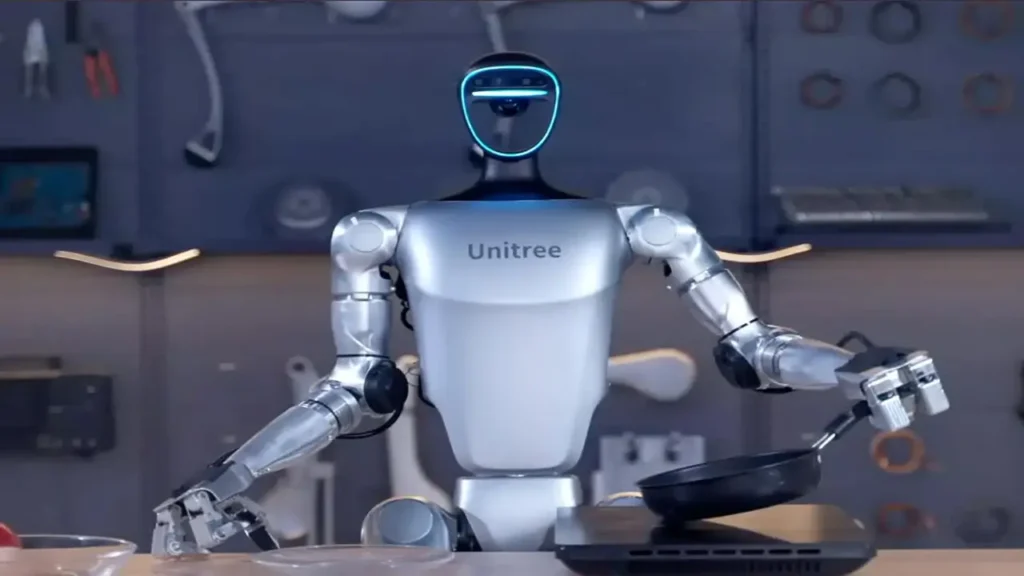
1. Home Humanoid Robots: Why This Is the Next Step After Robot Vacuums
Home humanoid robots represent a fundamental shift in how machines interact with our living spaces. While robot vacuums conquered one specific task—cleaning floors—humanoid robots are designed to navigate the full three-dimensional environment of a home and interact with objects the way humans do.
The logic is straightforward: our homes are built for people. Counters, shelves, doorknobs, light switches, and laundry baskets all exist at human height and require human-like manipulation. A vacuum can roll around the floor, but it can’t fold laundry, move dishes from the counter to the dishwasher, or retrieve something from a high shelf.
Companies like Tesla, Figure AI, and 1X Technologies are developing humanoid platforms specifically because the human form factor solves a critical problem: versatility. Instead of building a specialized robot for every task, one humanoid robot with sophisticated AI can theoretically learn dozens of different chores. This is the promise that’s driving billions in investment and research.
The transition from vacuums to humanoids also reflects advances in AI. Modern systems can process visual information, understand natural language commands, and learn from demonstrations—capabilities that simply weren’t possible when the first Roomba launched in 2002.
2. What Is Embodied Intelligence and Why “Embodied AI” Changes the Rules
When we talk about embodied AI robots, we’re describing systems where intelligence isn’t just processing information—it’s acting in the physical world. Unlike a chatbot that only manipulates text, an embodied AI system has sensors, actuators, and a body that lets it interact with real objects and spaces.
Embodied intelligence means the AI understands the physics of the world: gravity, friction, balance, and how objects respond to force. It knows that a glass can tip over, that a door needs to be pushed or pulled, that stairs require careful navigation. This knowledge comes from both training data and real-time sensory feedback.
The breakthrough is integration. Modern embodied AI systems combine computer vision (to see objects), natural language processing (to understand commands), motion planning (to move safely), and manipulation (to grasp and move things). Companies like Boston Dynamics and Agility Robotics have demonstrated robots that can navigate cluttered spaces, climb stairs, and recover from being pushed or tripped.
According to research from MIT and Stanford, embodied AI learns differently than traditional AI. When a robot physically attempts a task—like picking up a cup—it gets immediate feedback about what works and what doesn’t. This creates a learning loop that’s much more like how humans develop skills through practice.
The practical difference? A disembodied AI can tell you how to do laundry. An embodied AI robot can actually do your laundry.
3. Home Humanoid Robot: Definition and How It Differs from a Robot Vacuum
A home humanoid robot is defined by several key characteristics that set it apart from simpler household robots:
Physical structure: Humanoid robots have a torso, arms with hands or grippers, and often legs or a mobile base. This form factor allows them to reach objects at various heights and manipulate items designed for human use.
Manipulation capability: Unlike a vacuum that only moves and suctions, humanoid robots can grasp, lift, carry, and place objects. Their hands might have multiple fingers with individual control, or specialized grippers optimized for household items.
Height and reach: Most home humanoid robots stand between 5 and 6 feet tall, allowing them to access countertops, shelves, and other surfaces without requiring step stools or custom infrastructure.
Multi-task design: While a vacuum is purpose-built for one job, humanoid robots are designed as general-purpose platforms. The same robot that tidies your living room can theoretically help in the kitchen or sort laundry.
The robot vacuum taught us that autonomous navigation is possible. But navigation is just the foundation. The home humanoid robot builds on that foundation by adding the ability to meaningfully interact with the environment—not just avoid it.
Companies like Sanctuary AI and Apptronik are specifically targeting household applications, designing robots that can work safely around people and handle everyday objects without breaking them. This requires much more sophisticated sensing and control than what’s needed to vacuum under a sofa.

4. Navigation and Manipulation: Two Skills Without Which a “Home Android” Is Just Decoration
Robot navigation and manipulation are the twin pillars that make home humanoid robots functional rather than decorative. Neither skill is easy to master, and both must work together seamlessly.
Navigation challenges in homes:
Homes are dynamic, cluttered environments. A humanoid robot must build and update a map of its surroundings, recognize obstacles (including people and pets), plan safe paths through narrow spaces, and handle different floor surfaces. Unlike a factory floor with fixed layouts, homes change constantly—furniture gets moved, toys get scattered, doors open and close.
Modern navigation systems use LIDAR, depth cameras, and visual odometry to understand 3D space. The robot must know not just where walls are, but where it’s safe to step, how much clearance it needs to pass through doorways, and how to recover if it bumps into something unexpected.
Manipulation requirements:
Grasping and moving objects is even harder than it looks. The robot must:
- Identify objects and estimate their properties (weight, fragility, shape)
- Plan a grasp strategy that won’t drop or damage the item
- Apply the right amount of force—enough to secure the object, not so much that it crushes or breaks
- Maintain grip while moving, accounting for the object’s momentum and balance
- Place items precisely without knocking other things over
According to research from UC Berkeley’s AUTOLAB, successful manipulation in unstructured environments requires real-time force feedback, multiple grasp attempts, and sophisticated failure recovery. A robot that can’t adapt when something slips is a robot that can’t be trusted with your dishes.
The combination of navigation and manipulation is what enables useful work. The robot must navigate to the laundry basket, manipulate clothing items into the washing machine, navigate to the detergent, manipulate the cap and measure, and so on. Every household task is a chain of navigation and manipulation steps.
5. Real-World Scenarios: Which Chores Can You Actually Give to a Robot
Let’s be realistic about what a humanoid robot for chores can handle today versus what’s still in development. The gap between prototype demos and reliable daily use is significant.
Currently achievable tasks:
Object transport and organization: Moving items from one location to another is one of the most reliable applications. A robot can collect scattered toys, carry dirty dishes to the sink, or transport laundry between rooms. This requires moderate manipulation skills and is already demonstrated by several platforms.
Simple sorting: Separating items by category—lights from darks in laundry, or recyclables from trash—is possible with good computer vision and basic manipulation.
Light tidying: Putting items back in designated spots, straightening cushions, organizing shelves. These tasks are repetitive and well-defined, making them ideal for current robot capabilities.
Basic kitchen assistance: Unloading specific items from the dishwasher, wiping counters with a cloth, moving ingredients between prep areas. Full cooking is still too complex, but supporting tasks are within reach.
Still challenging:
Folding laundry: Despite progress from companies like Laundroid and research labs, reliable fabric manipulation remains difficult due to fabric’s unpredictable behavior.
Deep cleaning: Scrubbing, detailed dusting, and cleaning irregular surfaces require more dexterity and force control than most current systems possess.
Complex cooking: Following recipes, adjusting for variables, and handling hot surfaces safely involves too many edge cases for current autonomy levels.
The key is setting appropriate expectations. A home humanoid robot today is better thought of as an assistant that handles straightforward, repetitive tasks, freeing you for activities that require human judgment and creativity.
6. AI Household Assistant Robot and Smart Home: Integrations, Voice, Routines
An AI household assistant robot becomes significantly more useful when integrated into your broader smart home ecosystem. The robot isn’t operating in isolation—it’s part of a connected system that includes sensors, schedules, and automated routines.
Smart home integration capabilities:
Modern home humanoid robots can connect with platforms like Google Home, Amazon Alexa, Apple HomeKit, and Home Assistant. This allows coordinated actions: the robot might start tidying when your smart lock indicates everyone has left for work, or pause operations when motion sensors detect someone sleeping.
Voice control adds natural interaction. Instead of programming tasks through an app, you can simply say “Robot, please move the packages from the front door to the office” or “Tidy the living room before guests arrive at 6 PM.”
Routine automation:
The most powerful use of AI household assistant robots is scheduled, recurring routines:
- Every morning at 8 AM: collect breakfast dishes and deliver them to the dishwasher
- Each evening: patrol main rooms, collect items left out, return them to designated storage
- Weekly on Sunday: assist with laundry sorting
- When delivery notifications arrive: retrieve packages from the porch
These routines can adapt to sensor data. If the robot detects that a room is already tidy, it skips unnecessary work. If it encounters an unexpected situation—a spill, a closed door—it can notify you and wait for instructions.
Data sharing and learning:
Connected robots can learn your preferences over time. They notice that you always want coffee mugs in a specific cabinet, or that certain items should never be moved. This contextual understanding makes the robot more helpful without requiring constant explicit instructions.
The downside of connectivity is dependency: if your internet goes down or cloud services have issues, robot functionality may be limited. This is why many manufacturers are moving toward hybrid systems with essential functions available offline.
7. Safety: How Robots Should Behave Around Children, Pets, and Stairs
Robot safety at home isn’t optional—it’s the fundamental requirement that determines whether humanoid robots can actually live in our spaces. Unlike industrial robots that work in cages, home robots must operate safely around the most vulnerable members of our households.
Force limiting and collision detection:
Humanoid robots designed for homes use compliant actuators and force sensors to ensure they can’t apply dangerous amounts of pressure. If a robot’s arm encounters unexpected resistance—like accidentally contacting a child—it immediately stops and withdraws. This is similar to how collaborative industrial robots (cobots) are designed, but with even lower force thresholds suitable for home environments.
Stability and fall prevention:
A falling robot is a serious hazard. Home humanoid robots use advanced balance control, low centers of gravity, and wide stance positioning to prevent tipping. Some designs include active balancing systems that can recover from pushes or uneven floors.
Stairs deserve special attention. Robots must reliably detect stair edges and either navigate them safely (if stair-climbing capable) or maintain a safe distance (if not). Vision systems, LIDAR, and cliff sensors provide redundant edge detection.
Child and pet awareness:
Modern safety systems can identify small humans and animals specifically, adjusting behavior accordingly. The robot might reduce speed when children are nearby, avoid areas where pets are sleeping, or enter a passive mode when toddlers approach.
Physical features matter too: rounded edges, pinch-proof joints, and the absence of exposed hot surfaces or sharp components. Some robots include emergency stop buttons accessible to children.
Restricted zones:
You should be able to designate certain areas as off-limits: a baby’s nursery, a room with fragile collectibles, or anywhere you prefer the robot not enter. Virtual barriers are created through the robot’s mapping system.
Certification and standards:
Look for robots that meet relevant safety standards like IEC 61508 for functional safety or ISO 13482 for personal care robots. These certifications indicate third-party verification of safety systems.
The bottom line: a home humanoid robot should be safe enough that you’d feel comfortable leaving it operating while you’re in another room or briefly away from home.
8. Privacy: Cameras, Microphones, and Where Your Kitchen Video Goes
Robot privacy and data security concerns are valid and serious. A home humanoid robot is essentially a mobile surveillance system with cameras, microphones, and potentially other sensors constantly gathering information about your private life.
What data do these robots collect?
At minimum, most home humanoid robots capture:
- Continuous video from navigation cameras
- Audio from microphones (for voice commands and environmental awareness)
- 3D mapping data of your home’s layout
- Records of objects and their locations
- Usage patterns and schedules
- Possibly biometric data (face recognition for personalization)
Where does this data go?
This is the critical question. Robots handle data in several ways:
Cloud processing: Many AI tasks are computationally intensive. Some manufacturers send camera feeds, audio, or other data to cloud servers for processing. This enables more sophisticated AI but means your data leaves your home.
Local processing: Increasingly, manufacturers are building robots with powerful onboard computers that can handle AI tasks locally. This “edge computing” approach keeps sensitive data on the device.
Hybrid approaches: Some systems process routine tasks locally but use cloud resources for complex situations or learning updates.
Security measures to look for:
- End-to-end encryption: Data transmitted to cloud services should be encrypted so only you and the service can access it
- Local processing options: The ability to run in offline or local-only mode for maximum privacy
- Transparent data policies: Clear documentation about what’s collected, how long it’s stored, and who can access it
- User controls: Settings to disable cameras or microphones when not needed, delete stored data, or restrict what the robot can observe
- Physical indicators: LED lights that show when cameras or microphones are active
- Secure updates: Firmware updates delivered through signed, authenticated channels to prevent malware
Realistic privacy practices:
Even with these protections, you’re trusting the manufacturer with access to your home. Research the company’s privacy track record, read their data policies carefully, and consider:
- Disabling video recording features if you only need navigation
- Setting schedules so the robot doesn’t operate during private moments
- Reviewing what data is stored and deleting historical records you don’t need
- Using network segmentation to isolate the robot from other devices
Remember: convenience and privacy exist in tension. The more autonomous and intelligent the robot, the more data it typically needs. You’ll need to find your own comfort level with that tradeoff.

9. Cost of Ownership: Purchase Price, Service, Subscriptions, and Hidden Expenses
Understanding the true robot cost and subscription model requires looking beyond the initial purchase price. Home humanoid robots represent a significant investment with ongoing expenses.
Initial purchase costs:
As of early 2025, home humanoid robots in the consumer market range dramatically:
- Early consumer models: $20,000 – $50,000
- Advanced research platforms: $50,000 – $150,000+
- Enterprise/commercial units adapted for home use: $100,000+
These prices reflect the cutting-edge nature of the technology. For context, the first consumer robot vacuums cost $1,000-$2,000 when launched; today you can find capable models for under $300. Expect similar price drops as humanoid robot production scales up.
Service and maintenance:
Unlike software that just needs updates, robots are physical machines with moving parts:
- Regular maintenance (lubrication, sensor calibration, wear part replacement): $500-$2,000 annually
- Unexpected repairs (actuator failure, collision damage): $1,000-$5,000 per incident
- Battery replacement (after 2-5 years): $2,000-$8,000 depending on system
Some manufacturers offer service plans that bundle maintenance and repairs for a monthly fee, typically $200-$500/month.
Subscription costs:
This is where the ownership model gets complex. Many manufacturers are moving toward a “robot-as-a-service” approach:
- Basic cloud AI features: $30-$100/month
- Advanced capabilities (complex manipulation, learning new tasks): $100-$300/month
- Premium support and instant replacement: $200-$500/month
Some features might require subscriptions to continue working, even for hardware you own outright. Read the fine print carefully.
Hidden or unexpected costs:
| Expense Category | Estimated Annual Cost | Notes |
|---|---|---|
| Electricity usage | $100-$300 | Charging, always-on systems |
| Home modifications | $500-$5,000 | Charging station, storage, accessibility improvements |
| Insurance rider | $200-$800 | Liability coverage for robot-caused damage |
| Accessories | $500-$2,000 | Specialized grippers, cleaning attachments, upgrades |
| Network upgrades | $100-$500 | Better WiFi coverage, dedicated bandwidth |
Total cost of ownership example:
For a mid-range $40,000 robot with moderate usage:
- Year 1: $40,000 (purchase) + $1,200 (subscription) + $800 (maintenance) + $2,000 (setup/modifications) = $44,000
- Years 2-5: $1,200 + $1,200 + $300 (electricity/misc) = $2,700/year
- Five-year total: approximately $54,800
That’s roughly $11,000 per year or $916 per month. For comparison, hiring a part-time house cleaner at $25/hour for 4 hours weekly costs about $5,200 annually—though they provide different services.
Value proposition:
The question isn’t just “what does it cost?” but “what is it worth to you?” Consider:
- Time saved on household tasks
- Consistent completion of chores you dislike
- Assistance for those with mobility challenges
- Peace of mind for aging-in-place scenarios
For some households, the value clearly exceeds the cost. For others, the technology isn’t yet worth the investment. Your circumstances and priorities determine which category you fall into.
10. The Future: What Will Change in the Next 2-5 Years
The future of home robotics is being written right now in research labs, startups, and major tech companies. Based on current development trajectories and expert projections, here’s what’s likely to change by 2030.
Manipulation breakthroughs:
The biggest limitation today is dexterity. Robots struggle with flexible objects, delicate items, and tasks requiring fine motor control. But progress is accelerating:
- Tactile sensing systems that give robots a sense of “touch” are becoming more sophisticated and affordable
- AI trained on massive datasets of manipulation demonstrations is learning general-purpose grasping strategies
- Novel gripper designs—like soft robotics that adapt to object shapes—are moving from research to products
Within 2-3 years, expect robots that can reliably fold laundry, handle dishes without breaking them, and manage fabric items like towels and sheets.
Safety maturation:
As more robots enter homes, safety systems will improve through real-world data. Machine learning models will get better at predicting and avoiding dangerous situations. Industry-wide safety standards specific to home humanoid robots will emerge, giving consumers clear benchmarks.
We’ll likely see mandatory certifications and possibly insurance requirements, similar to how automobiles are regulated.
Cost reduction:
The economics are straightforward: as production volumes increase, prices drop. Companies like Tesla have explicitly stated goals of manufacturing humanoid robots at automotive-scale volumes, which could push prices below $20,000 by 2028-2030.
Component costs are falling too. Better batteries, cheaper sensors, more efficient motors—all drive down total system cost. The robot vacuum price curve suggests consumer home humanoid robots under $10,000 are possible within 5-7 years.
Capability expansion:
Near-term capability gains will focus on:
- More complex task sequencing (completing multi-step chores without human intervention)
- Better learning from demonstration (show the robot once, it remembers)
- Natural language understanding improvements (conversational task instructions)
- Enhanced environmental awareness (understanding context and adapting behavior)
Market normalization:
Home humanoid robots will transition from novelty to category. We’ll see:
- Multiple manufacturers offering competing products at different price points
- Established retail channels (not just direct sales)
- Third-party accessories and customization options
- Repair shops and service networks
- Used robot markets
- Rental and lease options for those not ready to buy
Integration deepening:
Robots will become central nodes in smart home ecosystems. They’ll coordinate with other devices, share data to optimize household operations, and potentially serve as physical interfaces for home automation (manually adjusting thermostats, checking if doors are locked, etc.).
Realistic timeline for mainstream adoption:
- 2025-2026: Wealthy early adopters, tech enthusiasts, and specialized use cases (mobility assistance)
- 2027-2028: Upper-middle-class adoption for households where the value proposition is clear
- 2029-2030: Mass-market options become available; mainstream households begin considering robots
- 2031-2035: Home humanoid robots become common in developed countries, similar to how dishwashers are common today
What won’t change:
Some limitations are fundamental and won’t disappear quickly:
- Robots won’t develop human-level common sense or judgment
- Complex, unstructured tasks will remain challenging
- Maintenance and repair needs won’t vanish
- Privacy and security concerns will persist
- Not every household will want or benefit from a humanoid robot
The bigger picture:
Home humanoid robots represent a technology shift comparable to personal computers or smartphones—not in speed of adoption, but in ultimate impact on daily life. The question isn’t whether this future arrives, but how quickly and what form it takes.
For those watching this space, the next 2-3 years are critical. We’ll see which companies survive, which approaches prove most practical, and whether early products deliver on their promises. The transition from impressive demos to reliable household tools is where the real work happens.
Conclusion
Home humanoid robots aren’t replacing humans—they’re handling tasks humans would rather not do. Powered by embodied AI, these systems represent the evolution from single-purpose machines like robot vacuums to versatile household assistants that can navigate, manipulate, and learn.
The technology is real, advancing rapidly, and getting closer to practical affordability. But it’s not magic. Today’s home humanoid robots have clear limitations in manipulation, autonomy, and cost. They require careful consideration of safety, privacy, and total ownership expenses.
For most people, home humanoid robots remain a few years away from making practical sense. For early adopters, specialized use cases, and those with specific needs like mobility assistance, the technology is already changing what’s possible.
The future of home robotics isn’t about whether robots will become part of our households—it’s about when, at what price, and with what capabilities. Based on current progress, that future is closer than most people think.
Humanoid robots are officially leaving the “sci-fi only” era — and Unitree G1 is a big reason why. It’s one of the most talked-about affordable (by industry standards) humanoids, built for real demos: movement, balance, and surprisingly precise hand control. And just when the hype was cooling down… Caviar dropped a luxury-style concept called “Aladdin”, turning the G1 into a viral flex for tech lovers and collectors.
In our new breakdown, we cover what makes Unitree G1 interesting, what the “Aladdin” wave actually means, and whether this is a real step toward home humanoids — or just a very shiny marketing rocket.
Read the full post here: https://aiinovationhub.com/unitree-g1-humanoid-robot-caviar-aladdin/
