
Remember when the future of immersive tech meant strapping something the size of a toaster to your face? Those days are fading fast. Spatial computing AR glasses from brands like XREAL, Rokid, and RayNeo are quietly changing the game, offering experiences that VR headsets promised but could never quite deliver for everyday use. This isn’t about choosing between virtual worlds and reality anymore—it’s about blending them in a way that actually fits into your life.
Let’s explore how these lightweight, surprisingly capable devices are making VR headsets look like yesterday’s news for most people, and why the glasses-shaped future is arriving faster than most tech forecasts predicted.

The Glasses Revolution: Why Lightweight Wins
Here’s the thing about spatial computing AR glasses: they solve the fundamental problem that’s plagued immersive tech since the beginning. Nobody wants to wear a heavy headset for hours. It’s that simple.
Traditional VR headsets typically weigh between 400-600 grams and cut you off from the world around you. They’re incredible for dedicated gaming sessions or specific professional applications, but they’re not something you’d casually put on to watch a movie on a plane or work on a spreadsheet in a coffee shop. AR glasses, by contrast, weigh as little as 75-85 grams—roughly the same as a pair of sunglasses.
This weight difference isn’t just about comfort. It represents a fundamental shift in how we think about immersive technology. Instead of creating isolated experiences that require dedicated time and space, AR glasses integrate digital content into your existing environment. You can wear them on the train, at your desk, or lounging on your couch without feeling like you’ve entered a different dimension.
The form factor matters more than you might think. When something is genuinely wearable—not just technically possible to strap to your head—it changes how often you’ll actually use it. XREAL, Rokid, and RayNeo have all focused intensely on making their devices look and feel like regular eyewear, understanding that social acceptability and practical comfort are just as important as technical specifications.
If you’re into Chinese tech breakthroughs, you’ll love what’s happening in China’s EV world too. BYD keeps pushing the envelope, and the new Xia MPV shows how far “family minivan” design has evolved: premium interior, smart features, and a clear Dynasty-style identity. Check the full interior breakdown and details here: https://autochina.blog/byd-xia-mpv-interior-dynasty-minivan-review/
How China Set the Pace: Manufacturing Excellence Without the Magic
Let’s address something that often gets wrapped in hype: why are Chinese companies leading the AR glasses charge? The answer isn’t mysterious—it’s about manufacturing infrastructure and market dynamics.
China’s electronics manufacturing ecosystem is unmatched for this type of product. The supply chain for displays, optical components, and miniaturized electronics is concentrated in regions where these companies operate, allowing for rapid iteration cycles that would take months or years elsewhere. When XREAL wants to test a new optical design, they can have prototypes in days, not weeks.
This speed advantage compounds. While competitors elsewhere are waiting for manufacturing quotes and shipping samples across continents, companies like XREAL, Rokid, and RayNeo are on their third or fourth design revision. They’re not working magic—they’re working efficiently within an ecosystem purpose-built for exactly this type of product development.
Price is another factor. These companies can deliver devices with premium Sony micro-OLED displays and advanced optics at price points that Western competitors struggle to match. XREAL’s devices start around $500, Rokid’s AR Lite kit launched at under $750, and RayNeo’s Air series sits in a similar range. Compare that to higher-end mixed reality headsets that often exceed $1,000 or even $3,500.
The combination of fast iteration, deep supply chain integration, and competitive pricing has allowed these brands to ship hundreds of thousands of units and gather real-world usage data while others are still in development cycles.
XREAL: The Ecosystem Builder
XREAL has taken a particularly smart approach to spatial computing AR glasses by focusing on compatibility and developer support. Their product line—from the Air series to the recently launched One and One Pro—emphasizes plug-and-play simplicity with an expanding range of devices.
The XREAL One series, powered by their custom X1 chip, represents a significant leap in standalone processing. This chip enables native 3 degrees of freedom (3DoF) tracking without requiring additional hardware or apps. That 3ms motion-to-photon latency they’ve achieved matters significantly for gaming and video—it’s imperceptibly fast, making motion feel natural rather than the slightly laggy experience that plagued earlier AR devices.
What sets XREAL apart is their ecosystem thinking. They offer the Beam Pro accessory for enhanced spatial computing, work with optical companies globally for prescription lens support, and have partnerships spanning from ASUS (the ROG XREAL R1 gaming glasses) to Google (Project Aura enterprise glasses). This isn’t just about making hardware—it’s about creating a platform.
The specs tell part of the story: 50-57° field of view depending on model, Sony micro-OLED displays delivering 1920×1080 per eye, 120Hz refresh rates, and multiple IPD adjustment options. But the real story is usability. XREAL glasses work directly with iPhone 15/16 via USB-C, Android devices, Nintendo Switch, Steam Deck, MacBooks, and gaming PCs. This “just works” approach removes the friction that killed earlier AR attempts.
Rokid: Comfort and Content First
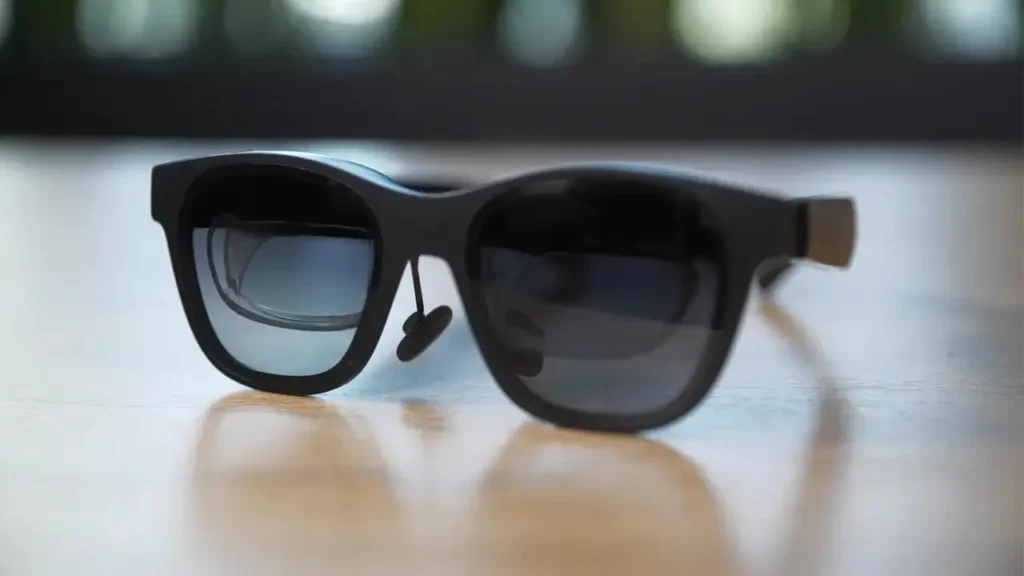
Rokid has carved out its position by emphasizing two things: wearing comfort and content accessibility. The Rokid Max 2 weighs just 75 grams and includes adjustable nose pads for fit customization—small details that matter enormously during extended use.
Their bundled approach with the Rokid Station creates a complete ecosystem. The Station 2 is essentially an Android-powered streaming box specifically designed for AR glasses, featuring a Qualcomm Snapdragon 6 Gen 1 chip, 8GB RAM, and 128GB storage. This eliminates the need to tether to a phone or laptop for many use cases—you can stream content, run Android apps, and manage multi-window workflows entirely through the Station.
The glasses themselves feature 50° field of view, micro-OLED displays with 600 nits brightness (1200 nits on the latest models), and built-in myopia adjustment from 0.00D to -6.00D. That last feature is particularly clever—it means users with mild to moderate nearsightedness can use the glasses without prescription inserts, and the device can be shared among family members with different vision needs.
Rokid’s AR Lite kit, which combines the Max 2 glasses with Station 2, demonstrates their understanding of what people actually want to do with AR glasses: watch movies with a massive virtual screen, work with multiple app windows floating in space, and game on their existing consoles or handhelds—all without complicated setup or compatibility headaches.
The company has also focused on privacy features, with their Whisper Mode audio technology that keeps sound localized to the wearer, preventing others from hearing what you’re watching or listening to.
RayNeo: Mass Market Vision with AI Integration
RayNeo approaches the market with perhaps the broadest product range, from the accessible Air series to the advanced X3 Pro with full AI integration. This breadth signals their strategy: offer entry points at multiple price tiers while pushing the technological envelope at the high end.
The Air 3s Pro showcases their display technology focus. At 1,200 nits to-eye brightness, these are among the brightest AR glasses available, making them genuinely usable outdoors—a problem that plagued earlier generations. The 201″ equivalent screen size at optimal viewing distance, combined with TÜV certification for eye comfort and their OptiCare technology with 3,840Hz PWM dimming, addresses the health concerns that have slowed consumer adoption.
But RayNeo’s most interesting product is the X3 Pro, which represents where the industry is heading. This device features full-color micro-LED displays (moving beyond micro-OLED), real-time Google Gemini 2.5 AI integration, 6DoF spatial tracking, and weighs just 76 grams. It’s not just a display—it’s a spatial computing platform with translation, navigation, and AI assistance built in.
The X3 Pro can run Android apps like TikTok, Instagram, and WhatsApp directly on the AR display, projects navigation arrows into your real-world view, and offers real-time translation across 14 languages with approximately 2.1-second response times. This is spatial computing in the fullest sense—digital information and assistance that adapts to and enhances what you’re actually doing.
RayNeo’s partnership with TCL as an Olympic AR/XR sponsor through 2032 also signals their long-term commitment and financial backing for continued development.
Format Showdown: Where VR Still Wins (and Where It Doesn’t)
Let’s be honest about what VR headsets do better. For fully immersive gaming where you want to be completely inside another world, VR remains superior. The enclosed field of view, spatial audio, and motion controllers create presence that AR glasses can’t match. Games like Half-Life: Alyx or Beat Saber are fundamentally VR experiences.
Similarly, professional applications like architectural visualization, surgical simulation, or complex 3D modeling benefit from VR’s complete environmental control. When you need to manipulate objects in three-dimensional space without real-world distractions, VR’s isolation is a feature, not a bug.
But here’s where AR glasses are winning: everything else.
| Use Case | VR Headsets | AR Glasses |
|---|---|---|
| Watching movies/videos | Isolated, heavy, limited battery | Perfect – giant screen, comfortable, portable |
| Working with documents | Impractical for extended periods | Excellent – multiple virtual monitors |
| Gaming (console/PC) | VR-specific titles only | All existing games on huge screen |
| Travel use | Bulky, socially awkward | Compact, discrete, travel-friendly |
| All-day wearability | Not realistic | Feasible with lightweight designs |
| Immersive VR games | Superior – dedicated controllers, 360° tracking | Not designed for this |
The key difference: VR headsets are purpose-built devices you use for specific activities. AR glasses are versatile displays you can integrate into multiple parts of your day. One requires commitment; the other offers convenience.
Display Technology: The Micro-OLED Advantage
The quality of spatial computing AR glasses hinges almost entirely on display technology, and this is where micro-OLED has emerged as the clear winner for current-generation devices.
Micro-OLED displays pack incredible pixel density—typically over 3,000 PPI—into screens smaller than a postage stamp. This creates crisp, detailed images even when magnified through optical systems. The technology delivers true blacks and contrast ratios exceeding 100,000:1 because each pixel emits its own light and can be completely turned off.
Sony dominates the micro-OLED supply chain, providing displays for XREAL, Rokid, RayNeo, and numerous other brands. Their latest ECX350F panels can achieve up to 10,000 cd/m² peak brightness—though glasses typically run at lower brightness levels for eye comfort and power efficiency.
The advantage over older LCD-based systems is dramatic. LCD requires backlighting, which adds thickness, power consumption, and heat. It also can’t achieve true blacks, resulting in washed-out images when viewing dark content. LCoS (Liquid Crystal on Silicon) suffers from similar limitations, requiring external light sources that bulk up the optical engine.
| Display Type | Advantages | Limitations |
|---|---|---|
| Micro-OLED | High contrast, compact, good brightness, mature technology | Potential burn-in, brightness degrades over time |
| Micro-LED | Extremely bright, no burn-in, long lifespan | Expensive, manufacturing challenges, limited availability |
| LCoS | Established technology, decent image quality | Requires external light source, bulkier optical engine |
Micro-LED represents the future—offering even higher brightness and no organic degradation—but manufacturing at the required pixel sizes remains prohibitively expensive. Companies like RayNeo are beginning to introduce micro-LED options at the premium end, but micro-OLED dominates the market for good reason: it’s available, proven, and delivers excellent results.
The optical system matters just as much as the display panel. These glasses use sophisticated lens assemblies and sometimes waveguides to project the tiny display into your field of view. The engineering challenge is maintaining image quality, field of view, and brightness while keeping the optical engine compact enough to fit in glasses frames. This is where companies differentiate—RayNeo’s Peacock Optics 2.0, XREAL’s proprietary optics, and Rokid’s systems each take slightly different approaches to balancing these trade-offs.
Connection and Portability: The USB-C Revolution
One of the quiet revolutions enabling portable AR display glasses is USB-C with DisplayPort Alt Mode. This single connection standard has unified compatibility across smartphones, tablets, laptops, and gaming devices.
Most current AR glasses are powered devices—they don’t contain batteries but instead draw power and video signal directly through USB-C. This keeps them light and eliminates charging anxiety. Plug them into your MacBook, Android phone, iPhone 15/16, Steam Deck, or even newer iPads, and they work immediately as an external display.
The latency matters significantly. XREAL’s X1 chip achieves 3ms motion-to-photon latency, which is fast enough that motion feels instantaneous. For context, most LCD computer monitors have 10-15ms of latency. This responsiveness makes AR glasses viable for gaming, not just video playback.
Some manufacturers bundle accessories to expand connectivity. Rokid offers HDMI adapters for connecting to PlayStation, Xbox, or any device with HDMI output. RayNeo’s JoyDock provides similar functionality while adding battery power for devices like the Nintendo Switch. These adapters transform the glasses from simple displays into versatile screens for any content source.
The “theater in your pocket” use case is particularly compelling for travelers. Instead of watching cramped content on a phone screen during flights, you get what appears as a 100-200 inch display floating in front of you. The glasses fold into compact cases that fit in a jacket pocket. No setup, no complicated pairing—just plug in and watch.
Power consumption varies by brightness and content, but most glasses draw 3-5 watts. This means you can watch several hours of video from a phone battery, or power them indefinitely from a laptop or power bank.

Real-World Gaming: What Actually Works
Let’s cut through the marketing and talk about what gaming experiences actually work well with smart glasses for gaming and which ones don’t.
Cloud gaming is probably the killer app. Services like Xbox Cloud Gaming, NVIDIA GeForce NOW, and PlayStation Plus streaming work brilliantly on AR glasses. You’re playing full console or PC games but on a virtual screen that dwarfs any television you could afford. Latency is determined by your internet connection and the service itself—the glasses add negligible delay.
The Steam Deck pairing is particularly popular among early adopters. You get the portability of a handheld with the visual experience of a large display. Same goes for ASUS ROG Ally or other PC handhelds. The XREAL partnership with ASUS even produced the ROG XREAL R1 specifically optimized for this use case, with 240Hz refresh rate support.
Console gaming via HDMI works well for single-player experiences. The large virtual screen enhances immersion in story-driven games. However, for competitive multiplayer where every millisecond matters, most serious players still prefer low-latency gaming monitors.
What doesn’t work well: games that require precision peripheral vision or rely on seeing the entire screen simultaneously. The field of view in AR glasses (typically 46-57°) is generous but not as wide as sitting in front of a monitor or TV. Games designed around peripheral awareness can feel constrained.
The experience is best described as having a personal IMAX screen for gaming. It’s not VR—you’re not moving your head to look around the game world. You’re looking at a really big, really good display that happens to be floating in space in front of you. For many gaming scenarios, especially portable gaming, this is ideal.
Battery-powered devices like the Switch benefit from the glasses’ low power draw. You can game longer because the Switch isn’t also powering a bright screen. For PC or console gaming, you’ll want the HDMI adapters that include power pass-through to keep your phone or handheld charged.

What’s Next: The 2026-2027 Inflection Point
The lightweight AR glasses we have today are impressive, but they’re just the beginning. Several technology trends are converging that will make 2026-2027 transformative years for spatial computing.
First, micro-LED displays will reach cost points that enable broader adoption. Current premium devices are testing these displays, but within 18-24 months, they’ll become standard in mid-range products. This means significantly brighter glasses that work seamlessly outdoors in direct sunlight—a current limitation that still affects adoption.
Second, on-device AI processing will expand dramatically. The XREAL X1 chip and similar solutions are first steps, but next-generation glasses will include neural processing units capable of real-time translation, object recognition, contextual assistance, and more—all without cloud connectivity. RayNeo’s X3 Pro shows where this is heading, but expect AI capabilities to become standard across product lines.
Third, prescription integration will improve. Current solutions require third-party lens inserts or adjustable diopters with limited range. Companies are working on direct prescription lens integration that looks and functions identically to regular prescription glasses. When you can walk into an optometrist’s office and order AR glasses that correct your vision while providing digital displays, adoption will accelerate.
Battery technology improvements will enable untethered options. While current powered-by-device approaches work well, truly standalone glasses with 6-8 hour battery life will unlock new use cases. Some companies are experimenting with battery packs that fit in the glasses’ arms or behind the ears, keeping weight distributed comfortably.
The “always-on” future isn’t about wearing displays constantly but about having digital assistance available without friction. Imagine glasses that normally look and function like regular eyewear but can instantly display navigation, translations, or notifications when needed. This ambient computing vision requires advances in display transparency, battery efficiency, and user interface design that are all actively being developed.
Pricing will continue dropping. As manufacturing scales and competition intensifies, expect capable AR glasses to reach $300-400 price points by late 2026, making them impulse-purchase territory rather than considered tech investments.
Enterprise adoption will drive consumer acceptance. Companies deploying AR glasses for field service, training, and remote assistance are normalizing the form factor. When people see practical benefits in work contexts, they’re more willing to try consumer versions.
The convergence is clear: lightweight, capable, affordable spatial computing AR glasses are becoming the preferred way to consume digital content outside of dedicated workstations. VR headsets aren’t disappearing—they’re finding their niche in immersive gaming and specialized applications. But for most people, most of the time, glasses win.
The brands leading this transition—XREAL, Rokid, RayNeo, and emerging competitors—aren’t selling future concepts. They’re shipping real products that work today, iterating rapidly based on user feedback, and building the spatial computing ecosystem that will define how we interact with digital information for the next decade.
The question isn’t whether AR glasses will replace VR headsets for everyday use. They already are. The question is how quickly the rest of the market catches on.
