
china low-altitude economy.If you’ve been following tech and mobility news out of China lately, you’ve probably noticed something curious: electric vertical take-off and landing aircraft (eVTOLs) aren’t just concepts anymore—they’re flying passengers, completing test routes, and earning regulatory approvals at a pace that feels almost surreal compared to the cautious rollout in Western markets. Welcome to China’s low-altitude economy, a sweeping policy-driven initiative that’s turning sci-fi dreams of air taxis and flying cars into commercial reality faster than most observers expected.
The low-altitude economy isn’t just about flashy aircraft demonstrations or billionaire vanity projects. It’s a deliberate, government-backed strategy to create an entirely new sector of economic activity below 1,000 meters (roughly 3,280 feet), encompassing everything from drone deliveries and agricultural aviation to passenger air taxis and emergency medical transport. China’s regulators have set ambitious targets, earmarked billions in infrastructure investment, and streamlined certification pathways that would make Western aviation authorities pause. Companies like Xpeng AeroHT and EHang are racing to capitalize, and the results are already visible in cities like Shenzhen, Guangzhou, and Hefei.
This article walks you through what’s actually happening on the ground (and in the air), why China’s approach differs so dramatically from Europe and North America, and what the next few years might look like as this ecosystem matures—or stumbles.
What china low-altitude economy actually means (and why it matters)
Let’s start with definitions, because “low-altitude economy” is a term you won’t find in ICAO manuals or FAA publications. It’s a China-specific policy construct introduced around 2021 and formalized in national planning documents including the 14th Five-Year Plan. Essentially, it refers to commercial activity conducted in airspace below 1,000 meters, leveraging new aircraft types, digital air traffic management, and urban infrastructure like vertiports.
Why does this matter? Three reasons:
Economic scale: China’s government estimates the low-altitude economy could generate over ₽2 trillion RMB (roughly $280 billion USD) in annual output by 2030, creating hundreds of thousands of jobs in manufacturing, operations, software, and infrastructure.
Urbanization pressures: Chinese megacities are dense, congested, and still growing. Ground transport is hitting physical limits. Low-altitude mobility offers a potential relief valve, especially for time-sensitive trips (airport transfers, emergency response, intercity hops).
Industrial policy: Just as China dominated EV battery supply chains, the low-altitude economy is seen as a chance to lead in next-gen aerospace. Early-mover advantage in certification, manufacturing scale, and operational data could position Chinese firms as global exporters by 2030.
The term itself bundles together drones (logistics, agriculture), general aviation (small planes, helicopters), and eVTOLs—but it’s the eVTOL segment grabbing headlines, because that’s where the regulatory acceleration and capital are concentrated.
If the low-altitude economy is the future of mobility, content localization is the fuel that helps it scale globally. The same applies to tech creators and brands: translating videos fast, syncing lips naturally, and keeping the voice authentic across languages. Here’s a tool worth checking: https://aiinnovationhub.shop/rask-ai-video-translator-lip-sync-voice/
The “low altitude economy policy” playbook: regulators, pilot zones, airspace rules
China’s low altitude economy policy isn’t a single document—it’s a layered strategy involving the State Council, Civil Aviation Administration of China (CAAC), Ministry of Industry and Information Technology (MIIT), provincial governments, and even the military (which controls most Chinese airspace).
Here’s how it works in practice:
Pilot zones: Over a dozen cities—Shenzhen, Hefei, Suzhou, Hangzhou, Chongqing—have been designated as low-altitude economy pilot zones. These cities get preferential treatment for airspace approvals, funding for vertiports, and fast-track certification support. Shenzhen, for instance, opened 27 low-altitude routes in 2023 and aims to expand to over 100 by 2025.
Airspace reform: Historically, Chinese airspace below 1,000m was tightly controlled by the military. Starting in 2021, select regions began delegating low-altitude airspace management to civilian authorities, allowing commercial operators to fly scheduled routes with simpler approval processes (sometimes just a filing, not a flight-by-flight permit).
Unified traffic management (UTM): China is building national UTM platforms—think air traffic control for drones and eVTOLs—using 5G networks, satellite positioning, and AI-driven conflict detection. The goal is real-time, automated coordination of thousands of low-altitude flights.
Subsidies and incentives: Local governments are offering grants for R&D, tax breaks for manufacturers, and co-funding for infrastructure. Hefei, for example, pledged ₽1 billion RMB to support eVTOL companies setting up production.
The result? A regulatory environment that’s unusually permissive by global standards—fast approvals, high tolerance for iterative testing, and strong political backing. It’s not without risks (safety oversight can lag), but it’s undeniably effective at accelerating deployment.

Why the “evtol market china” is scaling faster than the West
The eVTOL market China is outpacing competitors in Europe and North America for a few structural reasons:
Regulatory speed: CAAC issued its first type certificate for a passenger eVTOL (EHang EH216-S) in October 2023—years ahead of the FAA or EASA. While Western regulators demand exhaustive testing and multi-year reviews, CAAC has adopted a more iterative, “test-and-refine” posture, especially for pilotless designs.
Manufacturing scale: China’s EV supply chain (batteries, motors, composites) translates directly to eVTOL production. Companies can source lithium-ion cells, electric drivetrains, and avionics locally at lower cost and faster lead times than Western competitors relying on fragmented supply chains.
Capital availability: Despite a broader slowdown in venture funding, eVTOL startups in China raised over $1 billion USD in 2023–2024 combined (EHang, Xpeng AeroHT, AutoFlight, TCab Tech). Government-backed funds and state-owned enterprises are active investors, providing a cushion against market volatility.
Infrastructure rollout: Vertiports and charging stations are being built at city-government expense, not left to private operators. Shenzhen alone plans 100+ vertiport sites by 2026, with standardized designs and integrated permitting.
| Metric | China | USA | Europe |
|---|---|---|---|
| First passenger eVTOL certification | Oct 2023 (EHang EH216-S) | Expected 2025–2026 (Joby, Archer) | Expected 2025–2027 (Volocopter, Lilium) |
| Operational routes (2024) | 30+ commercial routes | 0 (demo flights only) | 0 (demo flights only) |
| Planned vertiports (2026) | 200+ across pilot cities | ~50 (mostly private sites) | ~30 (mostly demo sites) |
| Government funding (2023–2024) | ~$2B USD (est.) | ~$500M USD (grants, AFWERX) | ~$300M USD (EU programs) |
The gap is striking. While American and European companies are still navigating certification hoops and waiting for infrastructure, Chinese operators are logging revenue flights.
“Flying car china” vs eVTOL: terminology, designs, and what’s real in 2026
Let’s clear up the confusion around “flying car china” terminology. In Western media, “flying car” usually means a vehicle that can drive on roads and fly—think Terrafugia or PAL-V designs with fold-out wings and wheels. In China, the term is used more loosely to describe eVTOLs and hybrid designs, even if they never touch pavement.
What’s actually available or near-market in China:
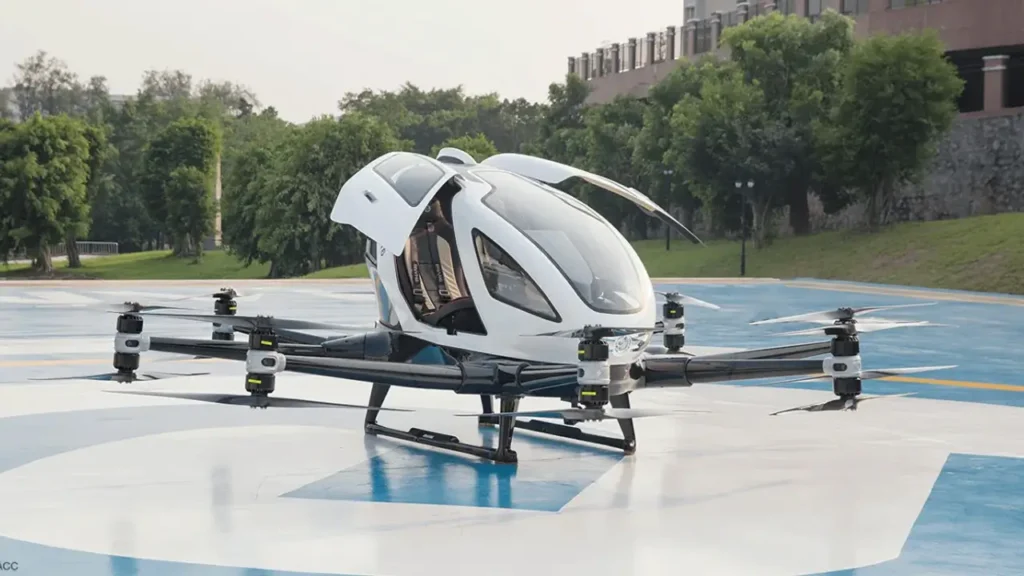
EHang EH216-S: Not a car at all—it’s a pilotless, two-seat eVTOL that looks like an oversized drone. Certified in 2023, operating tourist and demonstration flights.
Xpeng AeroHT X2: A two-seat, pilotless eVTOL focused on sightseeing and short hops. Wheeled but not street-legal; designed for vertiport-to-vertiport travel.
Xpeng AeroHT “Land Aircraft Carrier”: A modular system with a ground vehicle (an SUV) and a detachable two-seat eVTOL. The SUV carries the aircraft and can deploy it for flight, then pick it up after landing. Unveiled in 2024, targeting 2026 deliveries for early adopters.
AutoFlight Prosperity I: A lift-and-cruise eVTOL (transition design) with a pilot, seating 3–4 passengers. Focused on intercity routes.
So when Chinese companies say “flying car,” they usually mean an eVTOL optimized for short-range urban or suburban flights, sometimes with wheels for ground maneuvering but rarely for highway driving. The exception is Xpeng’s modular concept, which genuinely blurs the line by integrating road and air vehicles into one system.
In 2026, none of these are “consumer cars” you can drive to the grocery store and then fly home. They’re specialty vehicles requiring vertiport infrastructure, operator oversight, and (for crewed models) pilot licenses. The “flying car” branding is marketing—but the aircraft themselves are very real and flying.
“Urban air mobility china”: infrastructure, vertiports, dispatch, and safety layers
Urban air mobility China is moving from concept to concrete infrastructure faster than almost anywhere else. Here’s what’s being built:
Vertiports: Shenzhen has opened 10+ vertiports (essentially helicopter-style pads with charging and minimal passenger facilities), with 90 more planned by 2026. Hefei, Guangzhou, and Suzhou are following similar timelines. Designs are standardized to allow any certified eVTOL to land, charge, and take off with minimal friction.
Air corridors: Cities are designating low-altitude air corridors—think of them as highways in the sky—linking airports, business districts, hospitals, and tourist sites. Shenzhen’s initial network connects the airport, downtown, and coastal areas, with flights taking 10–15 minutes vs 40–60 minutes by car.
Unified dispatch platforms: Several cities are deploying centralized booking and dispatch systems (similar to ride-hailing apps) that aggregate multiple eVTOL operators, manage airspace slots, and handle dynamic pricing. Shenzhen’s platform, for example, integrates EHang, Xpeng, and smaller operators into a single user interface.
Safety and redundancy: Chinese eVTOLs use multiple redundant systems—distributed electric propulsion (if one motor fails, others compensate), parachute systems, and real-time health monitoring. CAAC requires extensive flight testing (EHang logged over 40,000 test flights before certification) and mandates geofencing to prevent flights over sensitive areas.
The infrastructure strategy is top-down: city governments lead, private operators follow. This is the opposite of the Western model, where private companies often have to lobby for permits and fund their own infrastructure. It’s faster, but also raises questions about long-term financial sustainability—many vertiports are loss-making and reliant on subsidies.
Xpeng’s bet: “xpeng aeroht flying car” roadmap, manufacturing, and go-to-market
Xpeng AeroHT flying car (formally the X2 and upcoming modular “Land Aircraft Carrier”) represents one of the most ambitious consumer plays in the sector. Xpeng, already a major EV maker, spun out AeroHT as a subsidiary in 2020 and has since invested over $500 million USD into eVTOL development.
Current status (January 2026):
- X2: Completed over 15,000 test flights, demonstrated publicly at auto shows and in Shenzhen/Dubai. Pilotless, two-seat, targeting tourism and sightseeing. Not yet commercially available for individual purchase but operating demonstration flights.
- Land Aircraft Carrier: Unveiled in late 2024, this modular system pairs a six-wheel electric SUV with a two-seat eVTOL. The SUV carries the aircraft on its roof, deploys it for flight, and retrieves it after landing. Xpeng claims a 35-minute flight range and aims to sell the system to ultra-wealthy early adopters for around ₽2–3 million RMB (~$280,000–$420,000 USD). Deliveries targeted for late 2026.
Manufacturing: Xpeng is leveraging its EV production lines and supply chain. The AeroHT factory in Guangzhou has capacity for 10,000+ units annually (though initial production will be far lower). Battery packs, motors, and avionics are shared or adapted from Xpeng’s car platforms, driving down costs.
Go-to-market: Xpeng’s strategy is two-pronged—B2C (selling to wealthy individuals as luxury toys/status symbols) and B2B (partnering with tourism operators, resorts, and municipal governments for sightseeing and short-haul routes). The company is also exploring export markets in the Middle East and Southeast Asia, where regulatory barriers may be lower.
The big question: can Xpeng navigate the gap between demo flights and a scalable, profitable business? The company’s deep pockets and EV expertise give it an edge, but consumer adoption of a $300,000+ “flying car” is still unproven.

EHang’s commercialization path: “ehang eh216-s” operations and use-cases
EHang EH216-S is the world’s first type-certified passenger-carrying autonomous eVTOL, and it’s already generating revenue. Here’s where it’s being used:
Tourist flights: EHang operates sightseeing flights in Hefei, Guangzhou, and at scenic spots like Mount Wuyi. Passengers pay ₽500–1,000 RMB (~$70–$140 USD) for a 10–15 minute flight. Demand has been strong, with some routes selling out weeks in advance.
Emergency services: Pilots in Guangxi and Yunnan provinces are testing the EH216-S for medical evacuation and emergency transport, leveraging its ability to land in tight spaces and bypass ground traffic.
Cargo logistics: EHang is deploying cargo variants (EH216-L) for deliveries in mountainous or island regions where road access is limited or expensive.
Urban mobility: Limited commercial air-taxi routes are operating in Shenzhen and Hefei, though these are still heavily subsidized and primarily serve as proof-of-concept.
| Metric | EHang EH216-S |
|---|---|
| Passenger capacity | 2 seats |
| Max range | ~30 km (18.6 miles) |
| Cruise speed | ~90 km/h (56 mph) |
| Flight time | ~20–25 minutes |
| Certification | CAAC Type Certificate (Oct 2023) |
| Autonomy | Fully pilotless (ground control oversight) |
| Estimated unit price | ~₽2–3M RMB ($280K–$420K USD) |
EHang’s advantage is its head start—three years of operational data, a certified aircraft, and a proven supply chain. Its challenges are range (30 km limits route options), noise (still louder than a car), and public acceptance of pilotless flight. The company is working on a next-gen model (rumored to extend range to 50+ km) and pursuing international certifications.
Certification reality check: “caac evtol certification” and what it unlocks
CAAC eVTOL certification is the gatekeeper to commercial operations, and it’s worth understanding what it actually entails—and what it doesn’t.
What CAAC certification requires:
- Flight testing: Thousands of test flights across diverse conditions (wind, rain, temperature extremes). EHang logged over 40,000 flights before approval.
- Redundancy and safety: Multiple independent flight control systems, emergency landing protocols, parachute systems (for some designs), and geofencing.
- Production consistency: CAAC inspects manufacturing facilities to ensure production aircraft match certified prototypes.
- Ongoing oversight: Certified aircraft are subject to maintenance audits, incident reporting, and airworthiness directives.
What certification does not guarantee:
- Profitability: A certified aircraft can still be too expensive, too noisy, or too limited in range to find commercial success.
- Operational approvals: Certification allows the aircraft to fly, but operators still need route approvals, vertiport access, and local permits—each flight path requires separate clearance.
- International recognition: CAAC certification isn’t automatically accepted by FAA or EASA. EHang is pursuing FAA approval but hasn’t obtained it yet, limiting its ability to operate in the US.
As of early 2026, only EHang has a full passenger type certificate. Several others—Xpeng X2, AutoFlight Prosperity I, TCab Tech E20—are in late-stage testing and expected to certify in 2026–2027. CAAC’s relatively fast process is a huge competitive advantage for Chinese manufacturers, but it also means global markets remain harder to crack.
The consumer layer: “personal air vehicle” adoption barriers (price, training, liability)
The dream of the personal air vehicle—owning your own eVTOL, parking it in your garage, and flying to work—is still far from reality, even in China. Here’s why:
Price: Current eVTOLs cost $300,000–$500,000 USD (or more), putting them out of reach for all but the ultra-wealthy. Xpeng aims to bring costs down to $100,000–$150,000 by 2030 through scale, but that’s still luxury-car territory.
Training and licensing: Piloted eVTOLs require a private pilot license (or equivalent), which takes months and thousands of dollars to obtain. Pilotless models sidestep this, but regulations in most markets (including China) still prohibit fully autonomous passenger flights without ground operator oversight.
Liability and insurance: Who’s liable if an eVTOL crashes—pilot, manufacturer, software developer, air traffic control? Insurance markets are still figuring this out. Premiums are high, and many insurers won’t cover autonomous passenger flights at all.
Infrastructure dependency: Personal ownership only makes sense if there’s a network of vertiports where you can land, charge, and park. Right now, that network exists only in a handful of Chinese cities, and access is often limited to commercial operators.
Noise and social acceptance: eVTOLs are quieter than helicopters but still generate 60–75 decibels at 100 meters—loud enough to annoy neighbors. Wealthy suburbs and apartment complexes may ban them, limiting where owners can actually use the aircraft.
The more realistic near-term scenario is fractional ownership or membership clubs, where affluent users share aircraft and operating costs, similar to private jet timeshares. Companies like EHang and Xpeng are exploring these models, but they’re niche markets at best.

Outlook: “air taxi china” scenarios for 2026–2030 + key risks to watch
So where is the air taxi China sector headed? Here are three scenarios for the next five years:
Optimistic scenario (2030):
- 500+ operational air-taxi routes across 20+ Chinese cities
- Ticket prices drop to ₽200–500 RMB ($30–$70 USD) per trip, making air taxis competitive with high-speed rail for short intercity hops
- Chinese eVTOL makers capture 30–40% of global market share, exporting to Southeast Asia, Middle East, and Latin America
- Personal ownership models emerge for ultra-wealthy (10,000+ units sold globally)
Base-case scenario (2030):
- 100–200 air-taxi routes, concentrated in 5–10 pilot cities
- Prices remain around ₽500–1,000 RMB ($70–$140 USD), limiting the market to tourists and business travelers
- Infrastructure rollout slows as subsidies taper and municipalities demand profitability
- Chinese firms dominate domestically but struggle with international certification and export
Pessimistic scenario (2030):
- Sector consolidates after a major accident or financial collapse of a leading player
- Regulatory pullback as safety concerns mount (battery fires, mid-air collisions, noise complaints)
- Market fragments into niche use-cases (tourism, emergency services) with limited scale
- International markets remain closed to Chinese eVTOLs due to geopolitical tensions or certification barriers
Key risks to watch:
Safety incidents: A fatal crash, especially involving a pilotless aircraft, could trigger regulatory crackdowns and kill public confidence.
Economic viability: Most routes are currently loss-making and subsidy-dependent. If local governments can’t or won’t continue funding, the sector could stall.
Airspace congestion: As eVTOL traffic grows, managing thousands of simultaneous flights will strain UTM systems. Mid-air conflicts or near-misses could force stricter limits.
Geopolitics: Export markets may impose bans or tariffs on Chinese eVTOLs, citing security concerns (data collection, remote control risks), similar to restrictions on Chinese drones and telecom equipment.
The most likely outcome? Somewhere between base-case and optimistic. China’s low-altitude economy has momentum—government backing, capital, infrastructure, and certified aircraft. But scaling from dozens of routes to hundreds, and from demonstration flights to mass-market adoption, will require overcoming cost, safety, and social acceptance hurdles that no amount of policy support can instantly solve.
What’s clear is that by 2030, China will either have established a commanding global lead in urban air mobility—or learned some very expensive lessons about the gap between technological capability and market reality. Either way, the next few years will be fascinating to watch.
FAQs: China’s Low-Altitude Economy & eVTOL Sector
Q: What is China’s low-altitude economy?
A: It’s a policy-driven initiative to develop commercial activity in airspace below 1,000 meters, encompassing drones, general aviation, and eVTOLs. The goal is to create a new economic sector worth over $280 billion USD by 2030.
Q: Are “flying cars” actually available for purchase in China?
A: Not yet for general consumers. Companies like Xpeng AeroHT and EHang are developing eVTOLs (often marketed as “flying cars”), with limited sales expected to ultra-wealthy buyers starting in late 2026. These are specialty aircraft, not street-legal cars that also fly.
Q: How much does an eVTOL air taxi ride cost in China?
A: As of early 2026, tourist flights cost around ₽500–1,000 RMB (~$70–$140 USD) for 10–15 minutes. Commercial urban routes are similarly priced but heavily subsidized. Prices are expected to drop as the sector scales.
Q: Is it safe to fly in a pilotless eVTOL?
A: CAAC-certified eVTOLs like the EHang EH216-S have extensive redundancy (multiple motors, flight computers, emergency parachutes) and have completed tens of thousands of test flights. However, the technology is new, and long-term safety data is still being collected. All flights have ground operator oversight.
Q: Can Chinese eVTOLs operate in the US or Europe?
A: Not yet. CAAC certification is not recognized by the FAA or EASA. Chinese manufacturers are pursuing separate certifications in those markets, but approvals are expected to take several more years.
Q: What’s the range of current eVTOLs?
A: Most current models (EHang EH216-S, Xpeng X2) have ranges of 25–35 km (15–22 miles) and flight times of 20–30 minutes. Next-generation models are targeting 50+ km ranges by 2027–2028.
Q: Will eVTOLs replace cars or trains?
A: Unlikely in the near term. eVTOLs are best suited for niche use-cases—airport transfers, scenic flights, emergency transport, short intercity hops where ground infrastructure is poor. They won’t replace mass transit but may complement it for time-sensitive or hard-to-reach destinations.
As China’s low-altitude economy continues to evolve, the world is watching closely. Whether this becomes a sustainable transport revolution or an expensive experiment will depend on technology maturation, regulatory wisdom, and ultimately, whether passengers are willing to trust their lives to electric aircraft piloted by algorithms. For now, the skies over Shenzhen and Hefei offer a glimpse of a possible future—one where air taxis are as routine as ride-hailing, and the phrase “I’ll just fly there” might not sound so crazy after all.
