
Introduction: Why Everyone Is Talking About the DJI Laptop
If you follow the world of tech and drones, you have probably already heard the buzz. The words “DJI laptop” have been floating around tech forums, YouTube comment sections, and creator communities for a while now — and for good reason. DJI, the company that practically invented the consumer drone market as we know it, has a long track record of entering markets and immediately dominating them. So when DJI laptop rumors start circulating, people sit up and pay attention.
At this point, there is no official announcement from DJI confirming any plans to build a laptop. But that has not stopped the speculation, and honestly, the speculation is well-founded. DJI has spent the last decade expanding far beyond drones into cameras, gimbals, action cameras, stabilizers, and even educational robotics. Every step has been calculated, polished, and market-defining. A DJI laptop would simply be the next logical leap.
This article digs into everything we currently know about the DJI laptop concept — the rumors, the possible specs, the design philosophy, how it might fit into the DJI ecosystem, and why creators, gamers, and tech enthusiasts are genuinely excited about the idea. Whether this machine ever becomes real or not, it is a fascinating thought experiment about what happens when one of the world’s most innovative hardware companies turns its attention to personal computing.
Why DJI Could Enter the Laptop Market
To understand why DJI technology makes perfect sense in a laptop, you need to understand what DJI actually is as a company — not just as a drone brand.
DJI, founded in 2006 by Frank Wang in Shenzhen, China, is at its core a precision engineering and imaging technology company. Their drones are remarkable not because they fly, but because of what they do while flying: stabilize video, process image data in real time, track subjects intelligently, and compress and store high-resolution footage efficiently. All of that requires custom silicon, proprietary software, advanced thermal management, and deep integration between hardware and firmware.
Sound familiar? Those are exactly the challenges that laptop manufacturers face every day.
DJI already designs its own chips, develops its own operating systems for embedded devices, and manufactures at massive scale with tight quality control. The company has built camera sensors, battery management systems, wireless transmission technology, and AI-driven object recognition — all in-house. These are not the capabilities of a company that simply assembles drones from off-the-shelf parts. This is a deep-technology company with the DNA to build serious computing hardware.
Beyond that, DJI has a direct, intimate relationship with one of the most demanding user groups in the world: content creators. Videographers, photographers, filmmakers, and aerial cinematographers use DJI products every single day. And every single one of those users eventually sits down at a laptop to edit their footage. DJI knows exactly what those people need, because those people are their customers.
The laptop market, while competitive, is not immune to disruption. Apple reshaped it with the M-series chips. ASUS disrupted the gaming segment with the ROG line. Huawei surprised everyone with the MateBook series. There is always room for a brand with a strong identity, a loyal user base, and genuine technical capability to carve out significant market share. DJI has all three.
What We Know About DJI Laptop Rumors
Let’s be straightforward: there is no confirmed DJI laptop release date. DJI has not made any official announcement about entering the personal computer market. Every piece of information circulating right now falls into the category of rumor, speculation, and logical inference.
That said, not all rumors are created equal. Some of the most persistent speculation around a DJI laptop comes from patent filings, job listings, and the general trajectory of DJI’s product expansion. Companies do not file patents for products they have no intention of building, and tech analysts have noted that DJI has filed patents in recent years covering display technology, thermal management systems, and computing architectures that go beyond what is needed for drone controllers.
There have also been reports from Chinese tech media — which tends to get early wind of hardware developments from Shenzhen-based companies — suggesting that DJI has internally explored the idea of a premium laptop aimed at content creators. These are not verified by DJI, but the sources have been credible in the past when it comes to Chinese consumer electronics news.
Community speculation on platforms like Reddit, Twitter, and dedicated drone forums has added texture to these rumors. Many of the most-discussed ideas point toward a DJI laptop release date sometime between 2025 and 2027 — though this is almost entirely speculative at this stage.
What makes these rumors particularly believable is timing. DJI has been systematically moving up the value chain and into adjacent markets. The DJI Osmo Pocket 3, the DJI Mic series, and the DJI RS stabilizer lineup all represent moves into professional creative tools that have nothing to do with drones. A laptop is the next frontier.

AndreevWebStudio.com
Professional web development and design services. Custom WordPress sites, landing pages, e-commerce solutions, and 3D printing content creation for businesses and creators.
- • WordPress Development
- • Custom Web Design
- • E-Commerce Solutions
- • 3D Printing Content
Could DJI Build the Ultimate Creator Laptop?
This is the question that gets creators genuinely excited. The idea of a DJI creator laptop is not just appealing because of the brand — it is appealing because of what DJI actually knows about the creation workflow.
Think about what a professional drone operator needs to do after a shoot. They need to offload large video files — often in 4K, 6K, or even 8K resolution — quickly and without corruption. They need to review footage, color grade, edit, and export in formats compatible with broadcast and streaming platforms. They need software that understands their camera’s color science, their drone’s telemetry data, and their stabilization metadata. They need a machine that is fast, has excellent color accuracy on its display, handles thermal loads during extended rendering sessions, and ideally has a battery that does not die mid-flight review.
A DJI creator laptop could theoretically address all of these needs natively, in a way that a general-purpose laptop from Dell or Lenovo simply cannot. Imagine a laptop that automatically integrates with DJI’s own LightCut or DJI Fly software, where flight logs sync seamlessly, where footage from your drone appears on your timeline already stabilized and color-matched, where the export settings know your drone’s specific codec profile.
This level of vertical integration is exactly what Apple has done with Final Cut Pro and the M-series chips. DJI could do the same thing, but specifically for the aerial and action camera creative community — a niche that Apple, despite its popularity with creatives, does not specifically target.
Expected features of a DJI creator laptop based on community discussions and logical inference might include a high color accuracy display (covering DCI-P3 or Adobe RGB), a custom media offload system optimized for DJI’s proprietary storage formats, native support for DJI’s color profiles and LUTs, fast NVMe storage with large capacity, dedicated GPU acceleration for video decoding, a long-lasting battery suited to field use, and a robust, weather-resistant chassis.
DJI Notebook: Expected Design and Hardware
When people talk about the DJI notebook concept, the design conversation is almost as exciting as the specs. DJI products are renowned for their industrial design — clean, precise, functional, and premium without being flashy. The Mavic series folds into a compact form factor that feels engineered to the millimeter. The DJI Osmo products have a tactile quality that competitors struggle to match. Whatever a DJI notebook looked like, you can be sure it would not look like a generic laptop.
Based on DJI’s established design language, here is what analysts and fans expect a DJI notebook to emphasize:
| Feature Category | Expected Specification |
|---|---|
| Display | 14–16 inch OLED or Mini-LED, 120Hz, DCI-P3 coverage, high brightness for outdoor use |
| Processor | Likely Qualcomm Snapdragon X or Intel Core Ultra, possibly custom ARM variant long-term |
| RAM | 16GB–64GB LPDDR5X |
| Storage | 1TB–4TB NVMe SSD with fast read/write for 6K/8K footage |
| GPU | Dedicated NVIDIA RTX or AMD Radeon for video processing |
| Battery | 80Wh+, optimized charging, possibly DJI’s own battery management tech |
| Ports | USB-C (Thunderbolt), USB-A, proprietary DJI media port, SD card reader, HDMI |
| Chassis | CNC-machined aluminum, dark matte finish, possibly IP-rated for light weather resistance |
| Weight | Under 1.6kg for portability in the field |
| OS | Windows 11 initially, potentially a custom DJI interface layer |
The design philosophy would almost certainly prioritize portability and durability over pure gaming performance. DJI users work in the field — on rooftops, in forests, on boats, at events. A DJI notebook would need to survive those environments while looking polished enough to sit on a desk at a post-production studio.
Could There Be a DJI Gaming Laptop?
Now here is where things get a little more speculative — and a little more fun. Could DJI produce a DJI gaming laptop? On the surface, it seems like an odd idea. DJI is not a gaming brand. Its audience skews toward outdoor creators and professional filmmakers, not esports players or PC gamers.
But consider this: the boundary between creative workstation and gaming laptop has been blurring for years. The same GPU that renders a AAA game at 4K 60fps is the same one that accelerates 8K video timelines in DaVinci Resolve. The same high-refresh-rate display that makes competitive shooters smooth also makes color grading footage a more fluid experience. Thermal management solutions developed for gaming laptops are directly applicable to sustained video rendering workloads.
If DJI built a creator-focused laptop with serious GPU muscle, it would inevitably overlap with gaming territory. Some brands — Razer being the most obvious example — have successfully straddled both markets by making machines that are premium enough for creative professionals and powerful enough for gamers.
A DJI gaming laptop is unlikely to be the primary pitch. But a high-performance DJI creator machine that also handles gaming well? That is entirely plausible, and it would appeal to the large cohort of drone pilots and creators who also happen to enjoy gaming in their downtime.
The key differentiator would still be the creative integration. DJI would not compete with ASUS ROG or MSI on raw gaming specs and aggressive RGB aesthetics. Instead, the DJI approach would be to build a machine that performs excellently across both workloads, wrapped in a sophisticated design that does not scream “gamer” — similar to how Razer positioned the Blade lineup as a creator-gaming crossover.
Integration With the DJI Ecosystem
One of the most compelling arguments for a DJI laptop is not the hardware itself — it is the DJI ecosystem that surrounds it.
DJI has built one of the most cohesive hardware ecosystems in consumer technology. Drones, cameras, stabilizers, microphones, and controllers all communicate seamlessly through DJI’s proprietary software stack. The DJI Fly app, DJI RC controllers, and DJI’s range of transmission systems (like O3 and O4) are all designed to work together without friction.
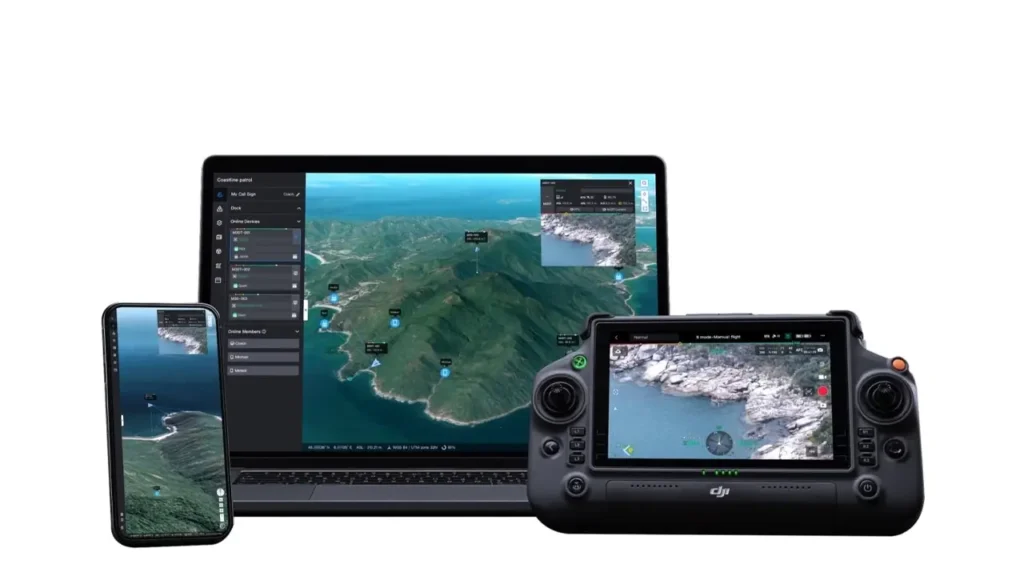
A DJI laptop sitting at the center of this ecosystem would be transformational for professional creators. Imagine connecting your DJI drone’s controller directly to your DJI laptop via a proprietary high-speed cable, and having your entire flight’s footage, telemetry, and metadata transfer instantly into an organized project on your desktop. Imagine the DJI laptop automatically recognizing your drone model and configuring the color workspace accordingly. Imagine real-time live view from your drone appearing on your laptop screen during a shoot, with the laptop simultaneously logging GPS data and battery status.
None of this is science fiction. DJI already does versions of all of these things with tablets and smartphones running the DJI Fly app. A purpose-built laptop with dedicated hardware acceleration for DJI’s protocols would simply do it better, faster, and more reliably.
| DJI Product | How It Could Integrate With a DJI Laptop |
|---|---|
| DJI Mavic / Air Series Drones | Automatic footage sync, flight log import, telemetry overlay in editing software |
| DJI Action 5 Pro | Direct USB-C transfer with auto-organization by session date and location |
| DJI RS Stabilizers | Stabilization metadata imported for software-level fine-tuning in post |
| DJI Mic 2 | Wireless audio sync with native timecode matching in editing apps |
| DJI RC Pro Controller | Use as a secondary screen or input device when connected to the laptop |
| DJI Goggles | Real-time FPV view output from laptop during connected flights |
This level of integration is something that no other laptop manufacturer can replicate, because no other laptop manufacturer has DJI’s product ecosystem. It is a genuine competitive moat.
How a DJI Computer Could Compete With Apple and ASUS
The laptop market is dominated by giants: Apple with its MacBook Pro line, ASUS with its ProArt and ROG series, Dell with its XPS and Precision range, and Microsoft with the Surface Studio. Competing against these players is no small task. But a DJI computer would not need to beat them everywhere — it would only need to beat them where it matters to DJI’s core audience.
Apple’s MacBook Pro M-series is currently the gold standard for video editing performance per watt. Its integration with Final Cut Pro is excellent, and it has a fiercely loyal creative user base. But Apple does not make any special accommodations for DJI users specifically. There are no native DJI protocols, no specialized media ports, no direct ecosystem benefits for drone operators.
ASUS ProArt laptops are excellent workstations with professional-grade displays and serious CPU/GPU performance. But they are generic workstations — designed for any creative professional, without a specific workflow target. They do not know whether you shoot video with a DJI drone or a Sony cinema camera.
A DJI computer would be neither of these things. It would be a purpose-built machine for a specific type of creator — the mobile content creator who shoots with DJI hardware. By being opinionated about its audience and deeply integrated with its own product family, a DJI laptop could command premium pricing and fierce loyalty in the same way that Apple does — not by being the best laptop for everyone, but by being the perfect laptop for someone.
Pricing speculation puts a potential DJI creator laptop in the $1,500–$2,500 range, competing directly with the MacBook Pro 14-inch and ASUS ProArt Studiobook — a crowded but profitable segment where brand identity and workflow integration are key purchasing drivers.
Future DJI Products Beyond Drones
To fully appreciate the DJI laptop possibility, it helps to zoom out and look at DJI’s broader trajectory of future DJI products. Over the past several years, DJI has made a series of moves that reveal a clear strategy: build the entire creative hardware stack, from capture to editing to delivery.
DJI new products in recent years include the DJI Osmo Pocket 3 (a compact cinema camera), the DJI Mic 2 (a professional wireless audio system), the DJI RS 4 Pro (a high-end camera stabilizer), and the DJI Avata 2 (an FPV drone for immersive creative filming). Each of these products shares a common theme: they help creators capture better content more easily, and they all funnel footage back to a computer for editing.
The one gap in DJI’s creative stack is the computer itself. Every other major player in creative hardware has recognized this. Apple builds computers optimized for creative work. Blackmagic Design — who makes DaVinci Resolve — released the Blackmagic Cloud Pod and integrated their software deeply with their hardware ecosystem. Sony has its Creator series laptops designed with content creation in mind.
DJI is the obvious next company to close this loop. And when you look at future DJI products through that lens, a DJI laptop is not just plausible — it starts to feel inevitable.
| Year | DJI Product Launch | Market Significance |
|---|---|---|
| 2016 | DJI Mavic Pro | Redefined portable consumer drones |
| 2019 | DJI Osmo Action | Entered the action camera market against GoPro |
| 2020 | DJI OM 4 Gimbal | Established DJI in smartphone stabilization |
| 2021 | DJI Mic | Moved into professional audio for creators |
| 2023 | DJI Osmo Pocket 3 | Launched a compact cinema camera category |
| 2024–2025 | DJI Action 5 Pro, RS 4 Pro | Cemented DJI as a full creative tools brand |
| TBD | DJI Laptop (rumored) | Would complete the end-to-end creator ecosystem |
Final Thoughts: Will the DJI Laptop Become Reality?
So, where does all of this leave us? The DJI laptop remains, for now, a rumor — an exciting, well-reasoned, highly plausible rumor, but a rumor nonetheless. There is no confirmed release date, no leaked specs sheet, no prototype photographs. What there is, is a compelling case built from DJI’s track record, its technological capabilities, its ecosystem, and the very real gap in the market that a DJI creator laptop could fill.
The DJI laptop rumors have taken on a life of their own because they reflect something real: the feeling that DJI is one of the few companies that could actually build a laptop that is transformatively better for a specific group of users, rather than just marginally different from what already exists.
Whether it arrives in 2025, 2027, or not at all, the conversation itself reveals something important about where the creative hardware market is heading. Users want integrated ecosystems. They want machines that understand their workflow, not just their file formats. They want hardware that feels like it was designed with them specifically in mind.
DJI has built its entire business on that premise. Every drone, every camera, every microphone they have ever shipped has been designed to fit into a creator’s life with minimal friction. A DJI laptop would simply be the natural conclusion of that philosophy.
Keep your eye on DJI’s announcements. If the company follows its pattern — systematic, strategic, and always slightly unexpected — the DJI laptop might just be the product that surprises everyone, while somehow also feeling completely inevitable. Until then, the DJI laptop rumors will continue to generate excitement, debate, and wishful thinking among creators who know exactly what they want from their next machine — and are starting to believe that DJI might be the one to finally give it to them.
