
The Minisforum AtomMan G7 PT landed on the scene with a bold promise — shove genuine desktop-class performance into a chassis smaller than a PlayStation 5 Slim. Not the usual mini PC marketing fluff where “powerful” really just means “it can run Chrome without sweating.” No, this machine ships with a full AMD Ryzen 9 7945HX processor and a discrete Radeon RX 7600M XT GPU, all crammed into a compact tower that sits neatly on your desk or next to your TV.
If you’ve been waiting for a mini PC that doesn’t make you feel like you’re sacrificing anything meaningful, the AtomMan G7 PT might be exactly what you’ve been looking for. Let’s dig in and figure out who should actually buy this thing — and who can safely wait.
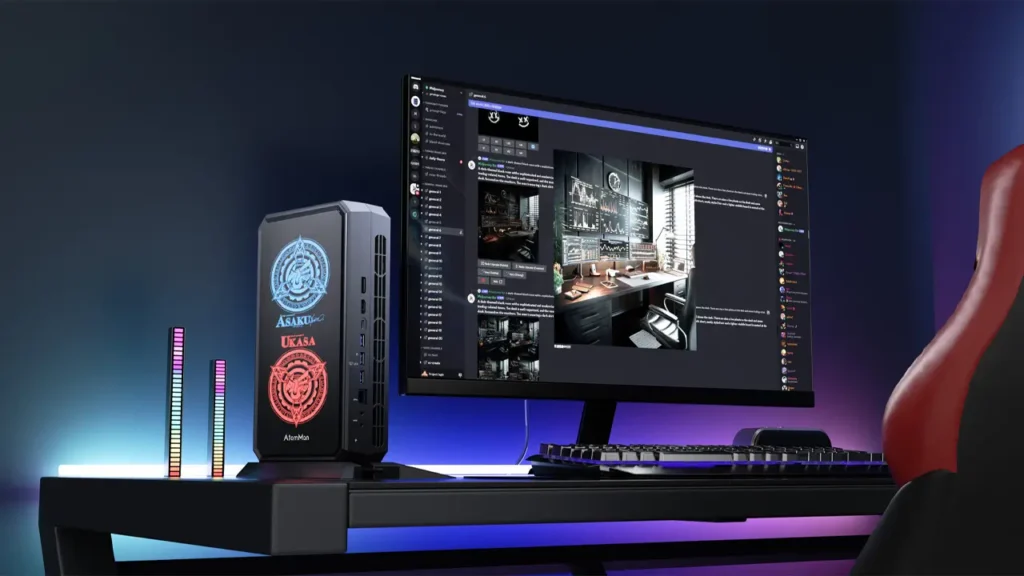
Why the Minisforum AtomMan G7 PT Could Be the Best Mini PC 2026
The mini PC market has exploded over the past two years. Every brand and their grandmother is slapping a processor into a small box and calling it revolutionary. So what makes the AtomMan G7 PT stand out from the noise?
The answer comes down to one thing most mini PCs simply refuse to do: include a discrete GPU. The vast majority of compact machines lean on integrated graphics — the kind that share system memory and cap out somewhere around “playable at very low settings.” Minisforum drew a line in the sand with the G7 PT by pairing the Ryzen 9 7945HX with the Radeon RX 7600M XT, a dedicated mobile graphics card with its own 8 GB of GDDR6 VRAM. That alone puts it in a completely different league.
On top of that, it earned AMD Advantage certification — the first mini PC ever to do so. It runs whisper-quiet under load thanks to Minisforum’s Cold Wave Ultra cooling system. And at current street prices hovering around $807–$999 (depending on configuration), it undercuts a lot of alternatives that don’t even come close on raw specs. For someone who wants a serious, no-compromise compact machine in 2026, this is genuinely hard to argue with.
Platform Deep-Dive: What “AMD Dragon Range Mini PC” Actually Means
Before we get into the nitty-gritty of benchmarks and gaming tests, it’s worth understanding exactly what platform you’re getting under the hood — because AMD Dragon Range is not just a marketing label.
Dragon Range is AMD’s codename for its high-performance mobile processor family built on the Zen 4 chiplet architecture. These are not the thin-and-light efficiency chips you find in ultrabooks. Dragon Range processors use the same 5 nm chiplet design as AMD’s desktop Ryzen 7000 series, which is why they punch so far above their weight class. The Ryzen 9 7945HX — the specific chip inside the G7 PT — is the flagship of the Dragon Range lineup, featuring 16 cores, 32 threads, and 80 MB of combined L2 and L3 cache.
What this means in practice is simple: you’re getting performance that’s remarkably close to a modern desktop processor, in a package that consumes a fraction of the power. Minisforum took this already impressive chip and gave it a generous 65W–85W power envelope (well above AMD’s base 55W rating), which helps squeeze out every last drop of single-threaded and multi-threaded performance. For a mini PC, that’s an unusually confident move — and it pays off.

CPU Spotlight: The Ryzen 9 7945HX Mini PC — Do You Really Need 16 Cores?
Let’s be honest. Most people don’t need 16 cores for everyday tasks. Email, web browsing, even video editing on a hobbyist level — a mid-range quad-core chip handles all of that without breaking a sweat. So why does the AtomMan G7 PT ship with the Ryzen 9 7945HX, and is there any scenario where all those cores actually matter?
The answer is: more often than you’d think.
The 7945HX is a Zen 4 all-big-core design. There are no efficiency cores to confuse the picture — all 16 cores are performance cores, clocked up to 5.4 GHz on boost. In single-threaded workloads like gaming, web browsing, or launching applications, the chip behaves like a single fast core, and the Zen 4 IPC improvements mean it’s genuinely snappy. But the moment you throw multi-threaded work at it — rendering a video in Premiere Pro, running a 3D model in Blender, streaming while gaming, or even running a local AI model — all 16 cores light up, and the G7 PT transforms into something that feels nothing like a mini PC.
Minisforum’s own testing claims up to 200% performance improvement over the Ryzen 9 8945HS in Cinebench R23 multi-core. That’s a significant gap, and it’s driven by the sheer core count and Zen 4 architecture working together. During PC Gamer’s real-world testing, the CPU stayed at a cool 69°C in Balanced mode (65W) and only climbed to 83°C in Performance mode (85W) — both perfectly healthy temperatures. No throttling. No thermal drama.
| Specification | AMD Ryzen 9 7945HX |
|---|---|
| Architecture | Zen 4 (Dragon Range) |
| Process Node | 5 nm (CCD) / 6 nm (I/O) |
| Cores / Threads | 16 / 32 |
| Base Clock | 2.5 GHz |
| Boost Clock | Up to 5.4 GHz |
| Cache (L2 + L3) | 80 MB |
| TDP in G7 PT | 65W (Balanced) / 85W (Performance) |
| Memory Support | DDR5-5200 MHz, Dual Channel |
So yes — if you’re a content creator, streamer, developer, or someone who multitasks seriously, that 16-core Zen 4 engine is not wasted here. It’s one of the main reasons reviewers keep coming back to the G7 PT.
GPU Breakdown: The Radeon RX 7600M XT Mini PC — Your 1080p and 1440p Sweet Spot
The graphics story is where the AtomMan G7 PT separates itself from virtually every other mini PC on the market. The Radeon RX 7600M XT is a discrete mobile GPU built on AMD’s RDNA 3 architecture, and it brings real, dedicated VRAM to the table — something you simply don’t get from integrated graphics.
Here’s what you’re working with: 32 compute units, 2048 stream processors, a game clock of 2300 MHz, and 8 GB of GDDR6 memory. That 8 GB of dedicated VRAM is a critical detail. It means the GPU isn’t eating into your system RAM to render frames — it has its own dedicated memory pool, which translates to smoother, more consistent performance, especially in titles that are texture-heavy or use higher-resolution assets.
In real-world testing, the RX 7600M XT handles 1080p gaming at high-to-ultra settings in the vast majority of modern titles without issue. Games like Cyberpunk 2077 and Tekken 8 ran smoothly in TechRadar’s testing. At 1440p, you’ll need to dial back some settings in the more demanding AAA titles, but for competitive esports games and less graphically intensive titles, 1440p is absolutely within reach.
PC Gamer summed it up well: pair this GPU with a 100Hz+ 1080p panel and you’re in high-frame-rate paradise. It’s not a 4K machine — don’t expect it to be — but for what it is and what it costs, the discrete GPU is the single best value proposition in the mini PC space right now.
| Specification | Radeon RX 7600M XT |
|---|---|
| Architecture | RDNA 3 |
| Compute Units | 32 |
| Stream Processors | 2,048 |
| Game Frequency | 2,300 MHz |
| VRAM | 8 GB GDDR6 |
| TGP | 120W |
| Avg FPS Uplift vs. Previous Gen | ~26% higher (per Minisforum) |
AMD Advantage Mini PC: What SmartShift and Smart Access Memory Actually Do for You
The AtomMan G7 PT holds a unique distinction: it’s the world’s first mini PC to earn AMD Advantage certification. That’s not just a badge for the marketing team — it means the system has been verified by AMD to run a specific set of smart technologies that are designed to work together seamlessly.
Two of the most important features here are Smart Access Memory and SmartShift. Let’s break down what they actually do, because the buzzwords can be confusing.
Smart Access Memory (SAM) is AMD’s version of what Nvidia calls Resizable BAR. It allows the CPU to access the full GPU memory directly, rather than going through a bottleneck that limits visibility to a small chunk at a time. The result? Faster data transfers between the processor and the graphics card, which translates to higher frame rates in supported games. It’s not a massive uplift in every single title, but in the ones that benefit, you can see meaningful FPS gains — and it costs you nothing to enable.
SmartShift is a dynamic power management technology. It monitors workload in real time and shifts power between the CPU and GPU based on what the system actually needs at that moment. Under heavy GPU loads — like gaming — more power flows to the graphics card. When you’re rendering video or crunching data, that power shifts to the CPU. The end result is that both components perform closer to their peak potential without either one becoming a bottleneck.
For the G7 PT specifically, these technologies work hand in hand with the all-AMD hardware stack. There’s no compatibility guessing game, no driver conflicts, no “oh, this feature only works on certain motherboards.” AMD Advantage certification means it all just works, out of the box. That’s genuinely valuable, especially for people who don’t want to tinker.

Gaming Focus: Why This Is the Gaming Mini PC AMD Users Will Actually Want
Let’s get into the reason most people are going to care about this machine: gaming.
The AtomMan G7 PT occupies a very specific niche — it’s a gaming PC that doesn’t look or feel like a traditional gaming desktop. No towering case. No tangled cables behind the desk. No intimidating hardware that makes you feel like you need an engineering degree just to set it up. It’s a compact box, about the size of two Steam Decks stacked together, that plugs in, powers on, and plays games.
And the games it plays are not just indie titles or browser-based time-killers. We’re talking about modern AAA titles — Cyberpunk 2077, Tekken 8, and similar demanding games — running smoothly at 1080p with high settings. The discrete RX 7600M XT makes this possible in a way that no integrated-graphics mini PC can match.
For AMD users specifically, there’s an additional layer of appeal. The all-AMD ecosystem means FSR (FidelityFX Super Resolution) support is baked in across a growing library of games. FSR lets the GPU render at a lower internal resolution and then upscale the image intelligently, boosting frame rates significantly without a dramatic drop in visual quality. On the RX 7600M XT, this can be the difference between a game running at 45 FPS and hitting 70+ FPS — a meaningful jump in playability.
The machine also connects to up to three 4K monitors simultaneously via HDMI 2.1, DisplayPort 2.0, and USB-C with Alt Mode. So if you’re the kind of person who wants to game on one screen while keeping Discord and a game guide open on two others, the G7 PT handles that without complaint.
Design and Cooling: A Compact Gaming Mini PC That Doesn’t Throttle
One of the biggest concerns with putting high-performance hardware into a small chassis is heat. More heat means thermal throttling, which means your processor and GPU automatically slow themselves down to avoid damage. It’s the silent killer of mini PC performance, and it’s the reason a lot of otherwise impressive compact machines fall flat in sustained workloads.
Minisforum took this problem seriously with the G7 PT. The machine uses the company’s patented Cold Wave Ultra cooling architecture — a system built around a vertical single heat pipe with dual air inlets and four fans (two on each side). Complementing that is an enhanced DDR/SSD active cooler and dual liquid metal heat pipes connecting the CPU and GPU cooling loops. The total system cooling capacity is rated at 205W, with fan noise staying at or below 45 dB even under load.
The vertical stand that ships with the G7 PT isn’t just aesthetic — it’s functionally critical. The cooling fans are mounted beneath the side panels, which means laying the machine flat would restrict airflow significantly. Standing it up, however, creates an efficient vertical convection path that lets hot air rise and escape naturally. In PC Gamer’s testing, the CPU stayed at 69°C during intensive Cinebench multi-core runs in Balanced mode. That’s excellent — well within safe operating limits, with plenty of thermal headroom to spare.
The design also includes a magnetic base that connects with a satisfying snap, and the power cable routes cleanly behind the stand. It’s a thoughtful layout that keeps your desk tidy without sacrificing any cooling performance.
| Feature | Details |
|---|---|
| Cooling System | Cold Wave Ultra — vertical heat pipe, dual air inlets, quad fans |
| Total Cooling Capacity | Up to 205W |
| Max Fan Noise | ≤ 45 dB |
| Dimensions (W × H × D) | 155 mm × 269 mm × 64 mm (without stand) |
| Weight | ~2.8 kg (incl. stand) |
| Stand | Magnetic, vertical orientation recommended |
| PSU | 300W external, 874g |
Real-World Testing: How the 1080p Gaming Mini PC Handles Esports and AAA Titles
Talk is cheap. Let’s look at what the AtomMan G7 PT actually does when you point it at real games.
At 1080p, this machine is an esports powerhouse. Competitive titles like League of Legends, Dota 2, Counter-Strike, and similar frame-rate-sensitive games run with high frame rates and minimal input lag. The Ryzen 9 7945HX’s single-threaded performance keeps the CPU from becoming a bottleneck in these titles, while the discrete RX 7600M XT delivers smooth, consistent visuals without leaning on shared system memory.
For AAA titles at 1080p, the picture is equally encouraging. Cyberpunk 2077 — one of the most graphically demanding games available — runs glitch-free according to TechRadar’s hands-on testing. Tekken 8, another visually impressive title, performed excellently. The key is that 8 GB of dedicated GDDR6 VRAM on the 7600M XT. It gives the GPU enough headroom to handle high-quality textures and effects without running into memory limitations.
Pushing to 1440p is possible, but it requires more nuance. In some titles — particularly esports and mid-tier games — 1440p runs beautifully. In the most demanding AAA titles at maximum settings, you’ll want to dial back some options to keep frame rates in the playable range. It’s a trade-off, not a dealbreaker, and AMD’s FSR technology can help bridge the gap in supported titles by boosting frame rates while maintaining respectable visual quality.
| Full System Specs | Minisforum AtomMan G7 PT |
|---|---|
| CPU | AMD Ryzen 9 7945HX (16C / 32T, up to 5.4 GHz) |
| GPU | AMD Radeon RX 7600M XT (8 GB GDDR6) |
| RAM | DDR5 Dual Channel, up to 96 GB @ 5200 MHz |
| Primary Storage | M.2 2280 PCIe 5.0 NVMe SSD |
| Secondary Storage | M.2 2280 PCIe 4.0 NVMe SSD (expansion) |
| RAID Support | RAID 0 / RAID 1 |
| WiFi | Wi-Fi 7 (M.2 2230 slot) |
| Ethernet | RJ45 2.5G |
| Display Output | HDMI 2.1 + DisplayPort 2.0 + USB-C (Alt Mode) — up to 3× 4K |
| Front Ports | 1× USB 3.2 Gen 2 Type-A, 1× USB 3.2 Gen 2 Type-C (data only), 1× 3.5mm combo jack |
| Rear Ports | 3× USB 3.2 Gen 2 Type-A, 1× USB 3.2 Gen 2 Type-C (Alt Data + DP), 1× LINE OUT, 1× MIC IN |
| AMD Advantage | Yes — World’s first certified AMD Advantage mini PC |
| Barebones Price | From ~$807 (street price, varies) |
| Full Config Price (32GB + 1TB + Win 11) | From ~$999–$1,199 (street price, varies) |
The bottom line for gaming: if you game at 1080p, the G7 PT is excellent. If you want to push into 1440p territory, it’s capable but selective. It’s not a 4K machine, and it shouldn’t be marketed as one. But for the size, the price, and the overall package, it’s one of the most compelling gaming mini PCs available today.
Verdict: Minisforum AtomMan G7 PT Review — Who Should Buy It, Who Should Skip It
After spending time with the specs, the benchmarks, the cooling data, and the real-world impressions from multiple trusted reviewers, here’s the honest summary.
Buy the Minisforum AtomMan G7 PT if:
You want a compact, quiet, capable gaming PC that doesn’t take up half your desk. You play primarily at 1080p and want high frame rates in both esports and modern AAA titles. You’re a content creator or multitasker who wants serious CPU power in a small package. You value the simplicity of an all-AMD ecosystem with verified smart technologies. You want a machine that doubles as a living room gaming PC next to your TV without looking out of place.
Skip it if:
You need 4K gaming performance — this isn’t the machine for that. You want the absolute smallest mini PC possible — the G7 PT is bigger than most compact mini PCs, and it needs to be used vertically. You’re on a very tight budget — while the street price has come down, it’s still a premium product compared to basic mini PCs. You have no use for a discrete GPU and only need integrated graphics for office or light creative work.
The Minisforum AtomMan G7 PT occupies a genuinely unique position in the market. It’s the first AMD Advantage-certified mini PC on the planet, it comes with a discrete GPU that most mini PCs wouldn’t dream of including, and it stays cool and quiet while doing it. It’s not perfect — the vertical-only orientation and the slightly larger-than-typical footprint will bother some people — but for what it delivers at its price point, it’s remarkably hard to argue against.
TL;DR: The Minisforum AtomMan G7 PT is a rare mini PC that actually means it when it says “gaming.” Discrete AMD GPU, 16-core Zen 4 CPU, 205W cooling, all in a compact tower. It’s the best all-AMD mini PC on the market right now, and it’s worth serious consideration if compact gaming power is what you’re after.
External references: Minisforum AtomMan G7 PT — Official Product Page | PC Gamer — AtomMan G7 PT Review | AMD Advantage Gaming Systems
If you’re into smart tech, you’ll love seeing how innovation is reshaping the road too. From Chinese EV breakthroughs to in-car AI and next-gen gadgets on wheels, the auto world is moving fast. Dive into the latest updates and trends here: https://autochina.blog/ — because the future isn’t parked, it’s accelerating.
